

Conversational analytics is the ability to ask questions of your business data in natural languageand receive computed, explainable answers, ideally with source citations. It turns analytics access from a specialist workflow into a direct conversation.
Why This Category Exists
Most organizations do not have a data shortage. They have an answer-access bottleneck. Business teams depend on analysts or dashboards built for yesterday's questions, so urgent decisions wait in queues.
Conversational analytics removes this friction. The interface is the question itself, and the output is a verified answer.
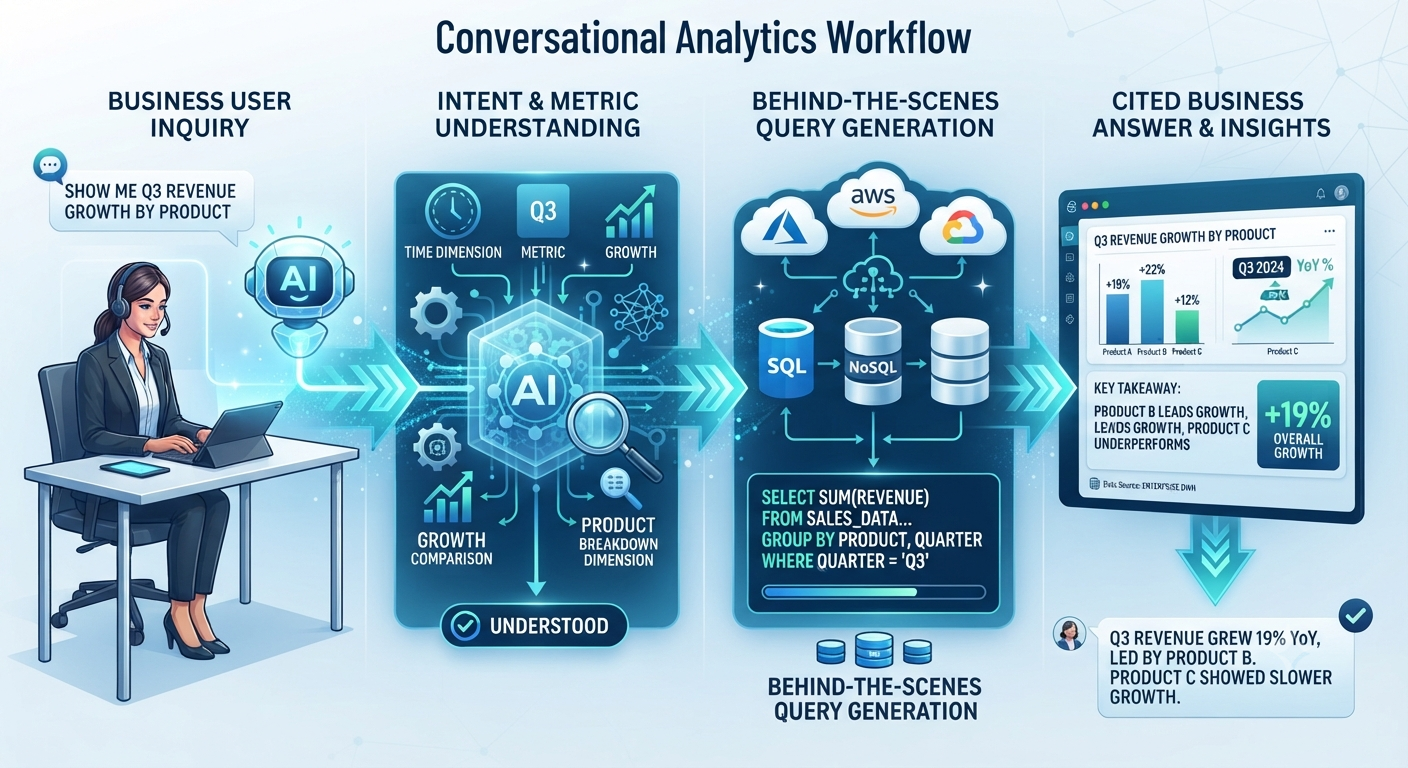
How Conversational Analytics Works
- Interpret the question: identify metric, dimension, filters, and timeframe.
- Generate the query: convert intent into SQL or equivalent logic.
- Run on live systems: execute against real warehouse or operational data.
- Return an evidence-backed answer: summarize in plain language and cite sources.
The query-generation step is natural-language-to-SQL. For a deeper breakdown, seeNatural Language to SQL.
Enterprise-Grade vs. Demo-Grade
- Live connections, not static file uploads.
- Citations and traceability, not black-box text answers.
- Ambiguity handling, where unclear questions trigger clarifications.
- Domain-aware semantics, so business definitions match your model.
- Governance controls, including role-based access and audit logging.
- Delivery flow, where trusted answers can become decision artifacts quickly.
Benefits and Limits
Benefits include faster access to numbers, fewer analyst interruptions, and less shadow reporting behavior. Limits are equally real: results depend on data quality, schema design, and governance discipline.
Conversational analytics is strongest on structured sources. For a practical data model view, see Structured vs. Unstructured Data.

Conversational Analytics in Commercial Real Estate
CRE teams ask recurring operational questions around occupancy, lease expiry, NOI movement, and CapEx variance. Those users are often non-technical, but they still need trusted answers fast. That is why this model fits owner-operators, finance teams, and portfolio managers especially well.
This is the operating model behindBayaan for Commercial Real Estate: governed, cited answers over real portfolio systems.
Frequently Asked Questions
What is conversational analytics in one sentence?
Conversational analytics is the ability to ask business-data questions in plain language and receive computed, evidence-backed answers without writing SQL. The strongest implementations also include source traceability and governance controls so answers can be used in real decision workflows.
Is conversational analytics the same as a chatbot?
No. A generic chatbot can produce fluent text, while conversational analytics is expected to compute results from live enterprise data. In practice, this means query logic, source grounding, and answer evidence are first-class requirements, not optional enhancements.
Do teams still need BI dashboards?
Usually yes. Dashboards are still efficient for recurring KPI monitoring and executive snapshots, while conversational analytics handles ad-hoc follow-up and exploratory questioning. The two approaches are complementary, with conversational analytics extending access between dashboard cycles.
Is it safe for enterprise use?
It can be, when implemented with enterprise controls such as role-based access, audit trails, policy enforcement, and environment-level data governance. Safety depends less on the interface style and more on deployment architecture and operational controls. Governance-first deployment is what turns conversational analytics from demo capability into production capability.