In this article
A commercial real estate AI assistant can answer questions about leases, occupancy, NOI, CapEx, rent rolls, and portfolio performance in seconds. That convenience creates a security question that is easy to underestimate:
Which data was the user actually allowed to retrieve?
A CFO may need portfolio-wide financial information. An asset manager may need detailed data for assigned properties. A regional manager may need access to one market. A joint-venture team may need information for one ownership structure but not another.
An AI system has to enforce those boundaries before it retrieves or queries the data. Otherwise, a user could potentially ask for information that exists somewhere in the portfolio simply because the model can reach it.
Role-based access control, or RBAC, provides a way to formalize those permissions around organizational roles and responsibilities. NIST defines RBAC as an access-control model in which permitted actions are associated with roles rather than individual identities.
For CRE AI, that model needs to extend beyond the application screen. Permissions have to shape what data can be retrieved, queried, aggregated, and ultimately exposed through the answer.
Key takeaways
- RBAC assigns permissions through organizational roles rather than creating a separate access model for every individual user.
- In CRE AI, authorization should affect the data retrieval or query path before an answer is generated, rather than relying on the model to hide sensitive results afterward.
- Portfolio permissions often need multiple dimensions: role, property, fund or JV, region, data domain, field sensitivity, and allowed action.
- Row-level and column-level restrictions can matter because a user may be allowed to see a property while still being restricted from specific sensitive fields.
- Aggregated outputs can still leak restricted information if a system allows users to infer sensitive records indirectly.
- Least privilege should guide both human and service-account permissions. Microsoft recommends granting only the access needed for the job and keeping role scopes as narrow as practical.
- Permission models need ongoing testing, review, and recertification because roles, portfolios, employment status, ownership structures, and responsibilities change.
What is role-based access control for CRE AI?
Role-based access control for CRE AI is a permission model that determines which data and actions an AI application can make available to a user based on the user's assigned role and authorized scope.
Traditional enterprise applications already use role-based permissions. An employee might have access to accounting functions, property operations, or asset-management records because those permissions correspond to their job responsibilities.
AI introduces another layer.
A conventional application may restrict which screen a user can open. An AI assistant may allow the user to ask a natural-language question that crosses multiple underlying tables, documents, and systems.
That means access cannot stop at the interface.
Consider:
“Show me all lease expirations in the portfolio over the next 12 months.”
The security system needs to determine which properties that user is permitted to see before the AI assembles the answer.
NIST's RBAC model associates permissions with roles, while users receive those permissions through their role assignments. This makes the policy easier to administer and review than maintaining large collections of individualized permissions.
For CRE, however, the role is only one part of the decision.
The permission may also depend on which entity, data domain, field, and action the user is requesting.
Why can't an AI system simply filter sensitive information after generating the answer?
Because post-generation filtering is too late to be the primary security boundary.
Suppose the underlying portfolio contains:
- acquisition underwriting
- property-level financials
- tenant information
- lease economics
- fund-level performance
- joint-venture data
- lender information
A user with access to one property asks an AI assistant:
“What is the average rent per square foot across all assets?”
If the AI can query the entire portfolio and calculate the result first, then hide individual properties afterward, the system has already crossed the intended access boundary.
There is another problem: the aggregated result itself may expose information the user should not know.
The safer model is:
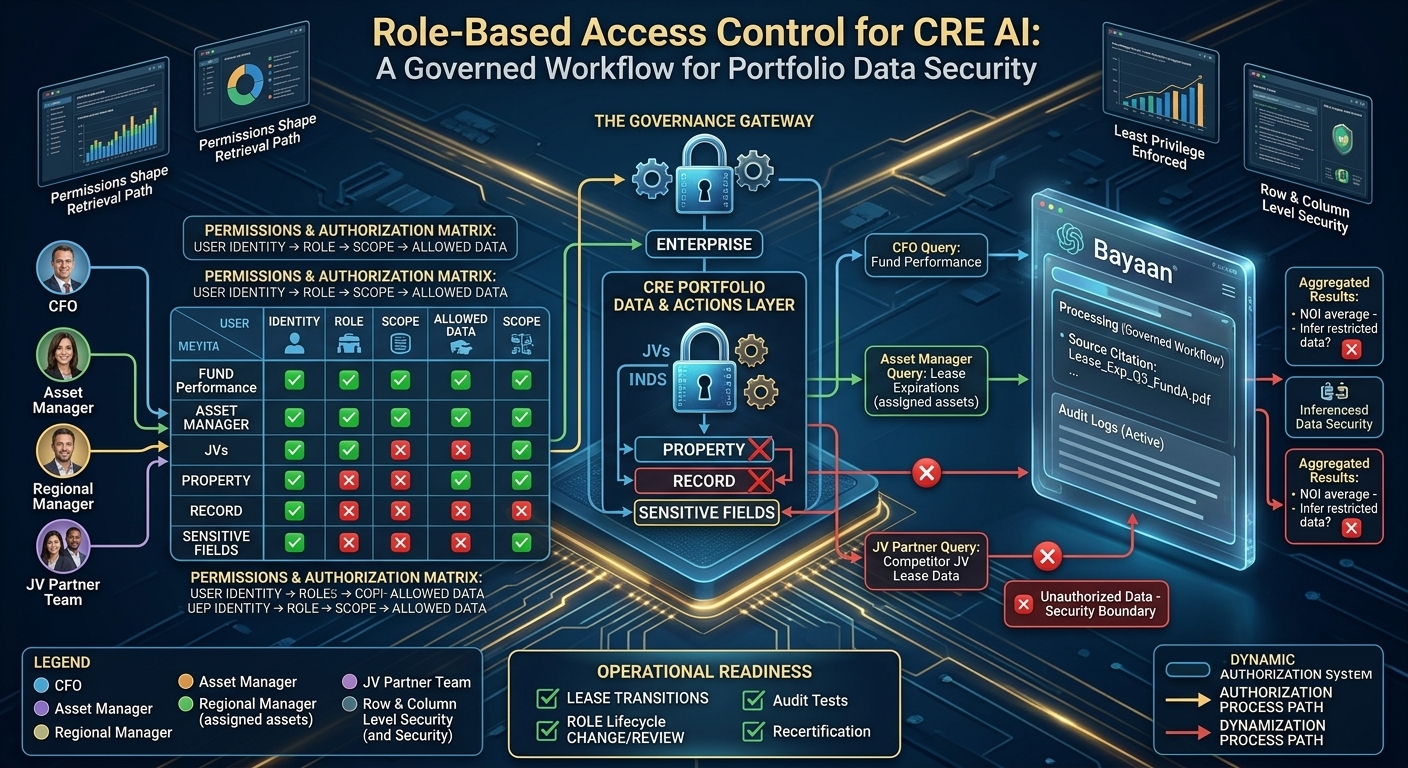
User identity → role → authorized scope → permitted data → query/retrieval → answer
rather than:
User identity → unrestricted retrieval → AI answer → attempt to remove sensitive details
This principle is consistent with least-privilege access control. NIST defines least privilege as granting an entity only the minimum system resources and authorizations needed to perform its function.
Microsoft's Azure guidance likewise recommends applying least privilege and assigning roles at appropriately narrow scopes rather than granting broader access simply because it is convenient.
What makes CRE access control different from a generic enterprise permission model?
Commercial real estate data often follows several overlapping structures at once.
A user may belong to a company-wide role but only be responsible for a subset of the portfolio.
For example:
Role: Asset Manager Region: Northeast Fund: Fund II Properties: Assigned office assets Data: Operating and leasing information Sensitive fields: Restricted acquisition assumptions Actions: Read and analyze
Another user might have:
Role: Finance Region: Enterprise Fund: Multiple funds Properties: Portfolio-wide Data: Financial records Sensitive fields: Compensation or legal information restricted Actions: Read, aggregate, export
This is why a single “Admin / User” permission switch is usually too crude for a complex CRE portfolio.
The access model has to reflect the actual ownership and operating structure.
What should a CRE AI permission model control?
A useful permission model can be thought of as five connected dimensions:
| Dimension | Example | Security question |
|---|---|---|
| User / Role | Asset manager, finance, executive, analyst | Who is asking? |
| Data Domain | Leases, NOI, rent roll, CapEx, budgets | What kind of information is requested? |
| Entity Scope | Property, region, fund, JV, portfolio | Which assets or ownership structures are in scope? |
| Field Sensitivity | Base rent, tenant contact, acquisition price | Are some attributes more restricted than the record itself? |
| Allowed Action | Read, query, aggregate, export, administer | What is the user allowed to do with the data? |
This becomes the foundation of the article's CRE AI Permission Matrix:
User/Role × Data Domain × Entity Scope × Field Sensitivity × Allowed Action
The matrix is more useful than a flat list of roles because it forces the organization to define what the role can actually do.
An “asset manager” is not automatically entitled to every field attached to every property.
Likewise, an “executive” may require broad portfolio visibility without needing unrestricted operational write permissions.
How do row-level and column-level permissions apply to CRE AI?
Row-level security controls which records a user can access.
Column-level security controls which fields within those records a user can access.
Both can matter in CRE.
Imagine a lease table containing:
| Property | Tenant | Lease Expiry | Base Rent | Credit Terms | Acquisition Notes |
|---|---|---|---|---|---|
| Property A | Tenant X | 2027 | $1.8M | Internal | Restricted |
| Property B | Tenant Y | 2028 | $2.2M | Internal | Restricted |
| Property C | Tenant Z | 2027 | $1.4M | Internal | Restricted |
An asset manager assigned to Property A might be allowed to retrieve the first row but not the others.
A finance user might be allowed to retrieve all three base-rent values but not acquisition notes.
An executive might receive an aggregate rent figure across a portfolio without being permitted to inspect every underlying record.
The AI application needs to respect those distinctions when constructing the answer.
This is also why application-level labels such as “This user can access the portfolio” can be misleading. Portfolio access does not necessarily imply access to every field within every record.
How should permissions work across funds, JVs, properties, and regions?
CRE organizations frequently operate with overlapping ownership and management structures.
A property might belong to:
Fund I → JV A → Property 17
while another belongs to:
Fund II → JV B → Property 42
An employee may work across the operating company but have approval to view only one fund.
The permission model should therefore represent the entity hierarchy explicitly.
A useful pattern is:
Enterprise → Fund → JV → Property → Building / Suite → Record
The exact hierarchy depends on the organization.
What matters is that the AI system can distinguish these scopes rather than treating “the portfolio” as one unrestricted dataset.
Azure RBAC itself uses hierarchical scopes, and permissions assigned at a parent scope can be inherited by child scopes. Microsoft's documentation also emphasizes that the selected scope determines how widely the role applies.
For an enterprise CRE AI application, those concepts need to be mapped to the application's own data-access model rather than assumed to happen automatically.
[[VERIFY: specific implementation claim about how Bayaan inherits or enforces permissions from a customer's underlying source systems.]]
What happens when an employee changes roles?
Permission systems often fail during transitions rather than during normal operations.
Consider an employee who moves from:
Asset Management → Corporate Strategy
Their old role might have allowed property-level access across one portfolio.
Their new position may require broader executive reporting but less access to detailed operational records.
If the permissions are not reviewed, the user can accumulate access instead of exchanging one permission set for another.
NIST's least-privilege guidance calls for reviewing assigned privileges and removing or reassigning them when they are no longer necessary.
A CRE AI permission program should therefore include a lifecycle:
Join → Role assignment → Scope assignment → Change → Review → Removal
The same principle applies when:
- an employee leaves
- a property moves between funds
- a JV structure changes
- a portfolio manager takes responsibility for new assets
- a contractor's engagement ends
- a department changes reporting responsibilities
Access should follow current responsibility, not historical access.
What is the difference between inherited permissions and AI-specific permissions?
An organization may already have permissions in its source systems.
That does not automatically mean an AI application can safely reproduce them.
There may be permissions in:
- identity systems
- databases
- document repositories
- BI platforms
- property-management systems
- enterprise applications
- the AI application's own project or workspace layer
The architecture needs to define which controls are authoritative for a particular data path.
Inherited permissions may reduce duplication, but the organization should verify what the AI layer actually enforces.
A permission that works correctly when a user opens a source application may not automatically protect the same information when an AI service queries that source through another access path.
This is one reason source-system inheritance claims need implementation-specific verification rather than assumptions.
What is aggregate leakage in a CRE AI system?
Aggregate leakage occurs when a user who cannot access individual records can still infer sensitive information from an aggregate result.
For example, imagine a portfolio contains only two properties in a restricted region.
A user cannot access either property's individual NOI.
But the user can ask:
“What is the combined NOI for the restricted region?”
If the result changes after the user asks which property contributed more, the AI may reveal information that individual record controls were intended to protect.
Similar problems can arise with:
- small tenant groups
- individual properties within a tiny peer set
- compensation-related data
- lease concessions
- transaction prices
- acquisition assumptions
- highly concentrated tenant exposure
A permission model therefore needs to consider not only record access, but also the information that can be inferred from permitted calculations.
This is especially important for conversational systems because users can iterate:
“What is the total?”
“What is the largest component?”
“What happens if you remove Property A?”
Each question can reveal another piece of the underlying information.
How should service accounts be handled?
AI applications often need service identities to access databases, documents, APIs, or other enterprise resources.
That identity should not become a back door around user-level permissions.
A service account with unrestricted read access to the entire portfolio can defeat an otherwise well-designed user RBAC model if the application fails to apply the requesting user's authorization before retrieval.
Microsoft recommends least-privilege access for Azure identities and resources, including limiting permissions and scopes to what is required.
The design question is therefore not:
“Does the AI have database access?”
It is:
“How does the AI use application credentials while still enforcing the requesting user's authorized data scope?”
A secure architecture needs a clear answer to that question.
How should a CRE AI Permission Matrix be designed?
The CRE AI Permission Matrix provides a practical way to document the policy.
Start with roles across the rows:
| Role | Data domain | Entity scope | Field sensitivity | Allowed action |
|---|---|---|---|---|
| Asset Manager | Leasing | Assigned properties | Standard lease fields | Query / analyze |
| Finance | Financials | Assigned funds | Financial detail | Query / aggregate |
| Executive | Portfolio performance | Portfolio-wide | Restricted detail | Read / aggregate |
| Leasing | Tenant / lease | Assigned region | Leasing fields | Query / analyze |
| Analyst | Approved datasets | Assigned projects | Depends on dataset | Query / analyze |
| Security Admin | Access metadata | Enterprise | Security configuration | Admin |
This table is only a model.
The organization's actual roles, scopes, and sensitive fields should come from its own operating structure.
Then test the combinations.
For each role, ask:
Can this user access the right records?
Can the user access the right fields?
Can the user ask the same question through another path and bypass the restriction?
Can aggregates expose restricted information?
Can a role change remove old privileges?
Can an administrator reconstruct why a user had access?
The matrix should be treated as a living control document rather than a one-time implementation artifact.
How should access controls be tested before deploying CRE AI?
Testing should include both obvious and indirect access paths.
A basic test plan can include:
Direct-access tests
Ask whether users can retrieve:
- an unauthorized property
- a restricted fund
- a restricted JV
- a sensitive field
- a document outside their scope
Cross-scope tests
Try questions that combine:
- authorized + unauthorized properties
- multiple funds
- multiple regions
- overlapping JVs
- historical + current records
Inference tests
Test whether aggregate or comparison questions reveal information indirectly.
Role-transition tests
Change a user's role and confirm that old access disappears when it should.
Service-identity tests
Confirm that application credentials cannot bypass the requesting user's authorization.
Audit tests
Verify that security administrators can determine what permissions were granted and whether those permissions were actually used.
What should happen when permissions are missing or ambiguous?
The safest behavior is not always to return an answer.
Suppose a user asks:
“Compare NOI for the entire portfolio.”
The system determines that the user's role covers only one fund.
It should not silently expand the query because the user appears to have a legitimate business reason.
Possible safe outcomes include:
Answer within authorized scope
“For Fund II, NOI increased 4.2% year over year.”
Clarification
“Your access includes Fund II. Should I compare the properties within that fund?”
Access limitation
“I can analyze the properties within your authorized portfolio scope, but I can't return results for the restricted funds.”
The important principle is that permission uncertainty should not be converted into broader access.
Where this falls short
RBAC is necessary for many enterprise CRE AI deployments, but RBAC alone does not create a complete security architecture.
Roles can be designed incorrectly. A perfectly implemented RBAC engine can still expose too much data if the organization's role definitions are too broad.
Portfolio structures change. Funds, JVs, property assignments, reporting structures, and employee responsibilities can change faster than permission documentation.
Inherited permissions can be misunderstood. A source application's permission model may not automatically map cleanly to the AI application's retrieval path. Implementation-specific verification is required.
Aggregates can leak information. Record-level restrictions do not automatically prevent inference from small groups or highly concentrated datasets.
AI query paths can introduce new access patterns. A user may reach the same sensitive information through a natural-language question that was never exposed through conventional application menus.
Service accounts can become over-privileged. An AI application with broad backend access can undermine user-level controls if user authorization is not carried into retrieval.
RBAC does not replace data governance. The organization still needs ownership, data classification, metric definitions, and a process for deciding which information is sensitive.
Turn portfolio questions into governed answers
See how Bayaan helps CRE teams connect governed business data, investigate portfolio questions, and generate trusted outputs.
Talk to BayaanWhat should a CRE buyer ask an AI vendor about RBAC?
Before approving an AI system for portfolio data, ask questions that test the enforcement point rather than the interface.
Where is authorization enforced?
Does the user's permission scope constrain data retrieval before generation?
Can access be restricted by property, fund, JV, region, or project?
Can access differ at the field level?
How are inherited permissions handled?
What happens when a user's role changes?
Can aggregates reveal information outside a user's authorized scope?
How are service identities prevented from bypassing user permissions?
What is logged when an access-controlled query is executed?
How are permissions tested and recertified?
A strong answer should describe the actual authorization path.
“Users have roles” is not enough.
The key question is whether those roles genuinely determine what the AI can retrieve or query.
How does Bayaan fit into this model?
Bayaan's documented product architecture includes role-based access control, full audit logs, per-project knowledge bases, and source citations. It is deployed in the customer's own Microsoft Azure environment, and the product is live for commercial real estate.
That makes RBAC part of the governed workflow rather than a separate administrative feature.
For a CRE deployment, the important evaluation remains the same:
Which user can ask what question against which authorized data?
The answer should be determined by the permission model before the system returns portfolio information.
How should a CRE team operationalize RBAC for AI?
Start with one data domain and one portfolio boundary.
For example:
Domain: Property operating data Scope: Fund II Roles: Asset Management, Finance, Executive Sensitive fields: Defined by the organization Actions: Query, aggregate, export, administer
Then document the permission matrix.
Next, test the difficult cases:
unauthorized property → denied
unauthorized fund → denied
restricted field → denied
aggregate inference → reviewed
role change → permissions updated
service identity → cannot bypass user scope
administrative change → logged
Only after those rules behave predictably should the model be expanded to leases, CapEx, rent rolls, valuation data, and other domains.
That approach also makes ownership clearer. Security owns policy, data owners define sensitivity and scope, application owners enforce the rules, and business owners confirm that the resulting access model matches how CRE teams actually work.
The technical implementation can differ across organizations, but the governing question stays constant:
Can the AI access only the information the user is authorized to use for the task?
That is the security boundary that matters.
---