In this article
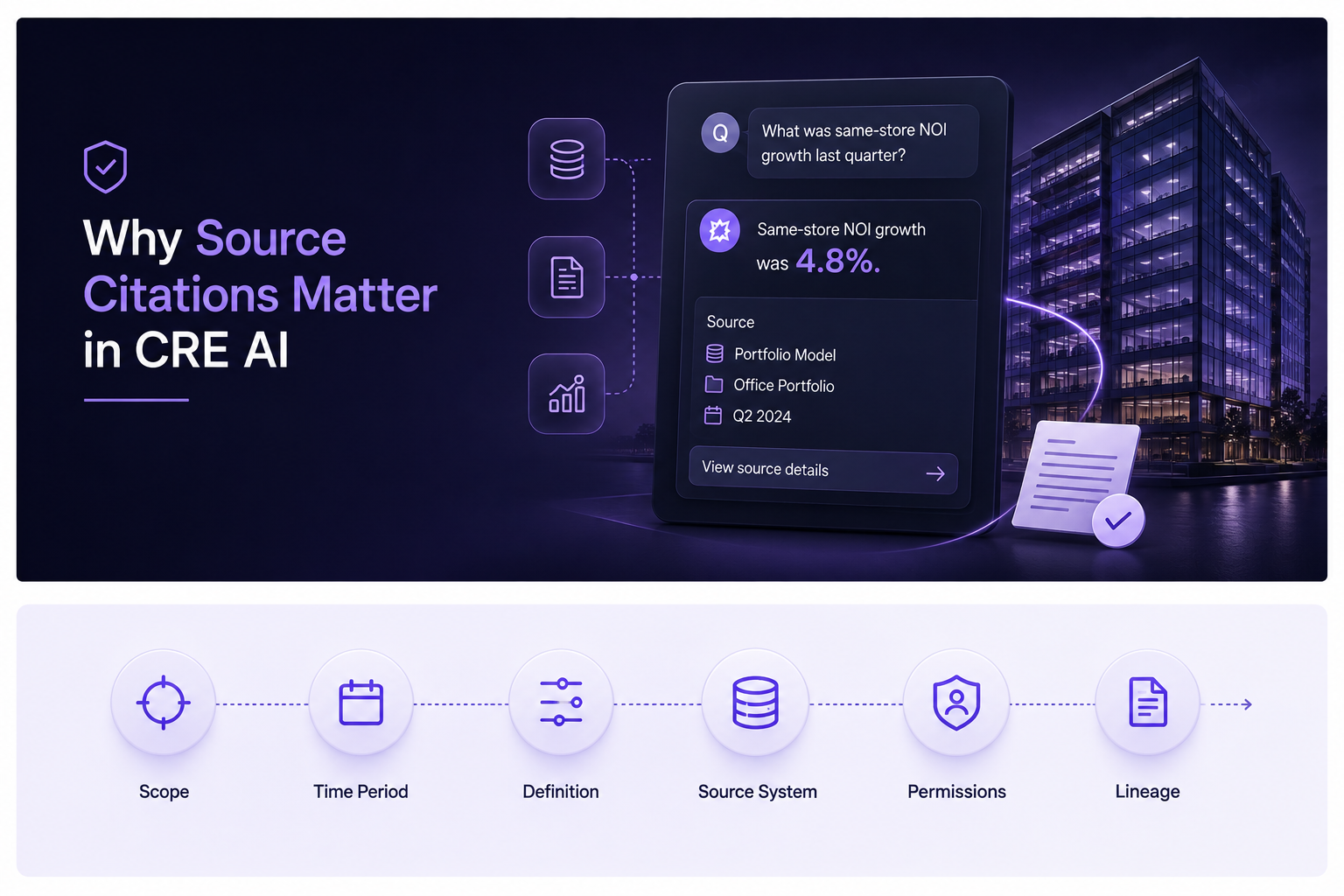
A portfolio analyst asks an AI system, “What was same-store NOI growth for the office portfolio last quarter?”
The system returns a number in seconds.
The real question starts after the answer.
Which properties were included? Which definition of same-store NOI did the system use? What reporting period did it apply? Did it pull the figure from the general ledger, a portfolio model, a spreadsheet, or a derived table? Was the user authorized to see every underlying property? Can another reviewer reconstruct the result later?
For commercial real estate, an AI answer becomes much more useful when the number comes with a source that can be reviewed.
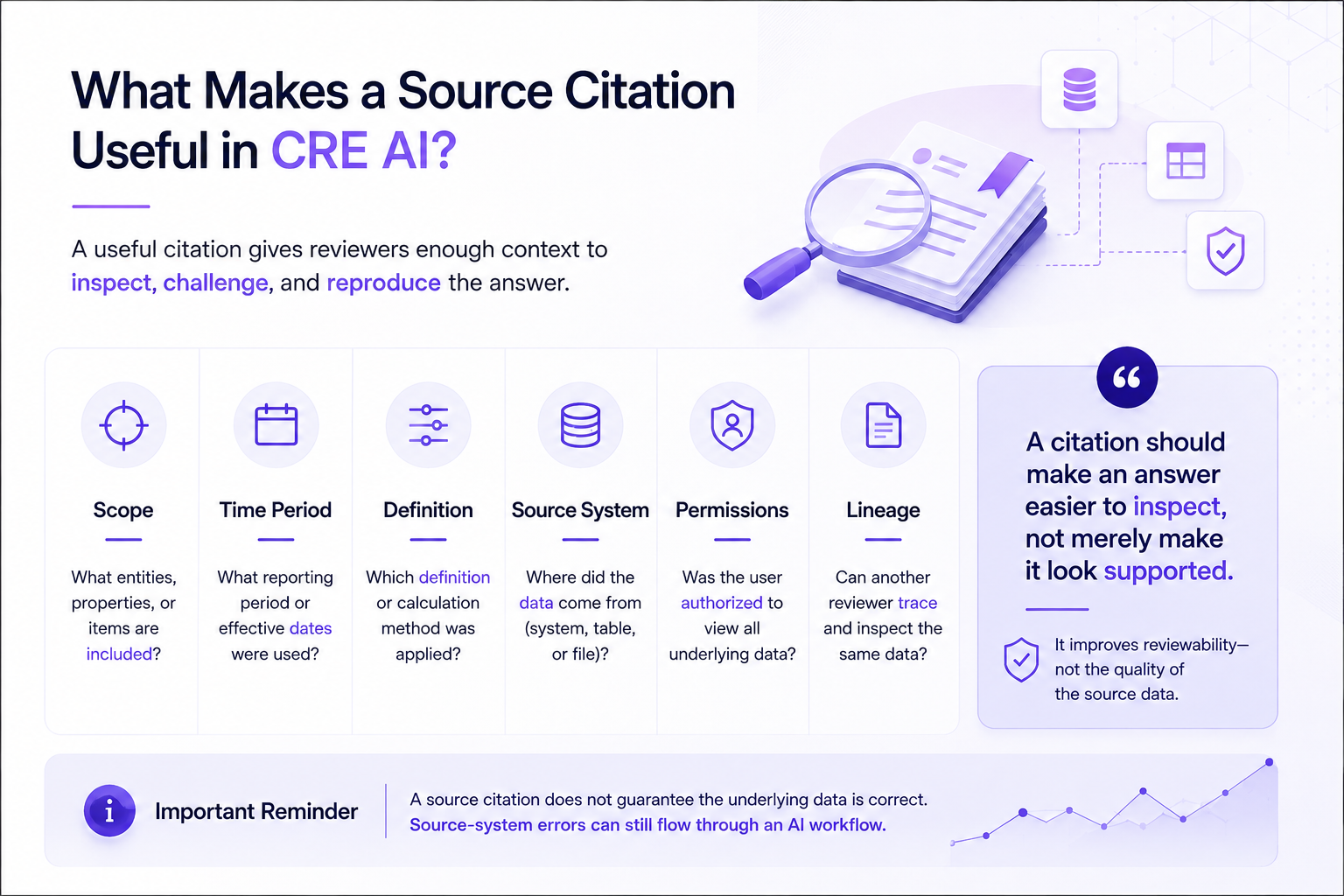
A source citation does not make an AI answer correct by itself. It does something more basic and more important: it makes the answer reviewable, challengeable, and reproducible. That distinction matters when AI-generated outputs move into investment committee materials, management reporting, lender packages, board presentations, or internal decisions.
Key takeaways
- A source citation shows where an AI-generated answer came from; it does not prove the underlying source data is correct.
- CRE citations need more context than a document name or database label. Reviewers need scope, definitions, timing, and relevant permission context.
- A useful citation lets a reviewer challenge a number without rebuilding the entire analysis from scratch.
- Citations are different from web links. A web citation points to published information; a CRE data citation should help trace an answer to internal records or governed source data.
- Source citations are most valuable when the answer will influence a consequential decision or become part of a formal business deliverable.
- Strong citation practices should expose uncertainty and assumptions rather than create false confidence.
- Source-system errors can still flow through an AI workflow. Better citations improve reviewability, not the quality of an incorrect source.
What is a source citation in an AI-generated CRE answer?
A source citation identifies the underlying business information used to support an AI-generated answer.
In a commercial real estate context, that source might be a rent roll, general-ledger table, lease record, budget dataset, occupancy table, property-level operating statement, or another governed business source.
The purpose is not simply to display a label such as “Rent Roll.xlsx.”
The useful question is:
Can another authorized reviewer understand what data was used to produce this answer and inspect enough context to challenge it?
That is closer to data provenance than conventional citation formatting. NIST defines provenance as information about the origin, development, ownership, location, and changes associated with a system or data, including relevant people and processes.
For AI systems, this matters because the model can produce a fluent answer even when the underlying reasoning or supporting information is wrong. NIST's Generative AI Profile explicitly identifies confabulation as a risk and notes that generated citations themselves can sometimes be misleading, which is why the presence of a citation should not be treated as automatic proof of correctness.
The practical standard for CRE is therefore:
A citation should make an answer easier to inspect, not merely make it look supported.
Why does source traceability matter more for CRE than a simple “trust the AI” workflow?
Commercial real estate data contains definitions, hierarchies, effective dates, ownership structures, and reporting conventions that can change what a number actually means.
Consider the question:
“What is portfolio occupancy?”
That question sounds simple until the reviewer asks whether the answer uses physical occupancy, leased occupancy, economic occupancy, or another firm-specific definition.
The same issue appears with NOI. A reported figure may depend on property scope, reporting period, expense treatment, same-store inclusion rules, or whether certain assets were acquired or disposed of during the period.
The AI model may generate a perfectly grammatical answer. The problem may sit underneath the model in the data definition.
That is why citations matter even when an organization already trusts its AI platform. The citation creates a place for the reviewer to investigate assumptions instead of accepting the output because it sounds plausible.
NIST's AI Risk Management Framework is designed to help organizations manage AI risk across development, deployment, and use, and its Generative AI Profile highlights the need to manage risks associated with generated content and consequential decisions.
For CRE, that translates into a straightforward operating principle:
The higher the consequence of the answer, the stronger the requirement for traceability.
How is a CRE source citation different from a web citation?
A web citation normally helps a reader navigate to a published source.
For example, an article might cite a government report, research paper, or public market statistic. The reviewer can open the source and assess whether the author's statement matches the published material.
A CRE data citation has a different job.
The underlying source may not be public at all. It could be an internal database record, a lease table, a reporting dataset, or a controlled financial system.
The reviewer therefore needs enough information to answer questions such as:
| Citation question | What the reviewer needs |
|---|---|
| Source | Which system, table, document, or governed dataset was used? |
| Scope | Which properties, tenants, leases, funds, or entities were included? |
| Definition | What does the metric mean in this organization? |
| Time | Which period, effective date, or data snapshot was used? |
| Permission context | Was the answer produced using data the reviewer is authorized to inspect? |
| Reproducibility | Could the organization reconstruct the result later? |
This is the basis of the Citation Acceptance Standard for CRE AI.
A citation that says “Portfolio Data” may look reassuring while telling the reviewer almost nothing. A citation that identifies the relevant source, scope, metric definition, reporting period, and reproducibility context gives the reviewer a practical verification path.
What should a good AI citation show?
A useful citation should answer six questions.
1. Source
Where did the supporting information originate?
The answer might point to a specific governed dataset, property-level record, financial source, or document collection rather than simply saying “internal data.”
2. Scope
What entities were included?
For CRE, this could mean:
- specific properties
- a fund
- a joint venture
- a region
- a tenant group
- a subset of leases
Scope matters because an answer can be numerically correct for the wrong portfolio.
3. Definition
What does the metric mean?
“Occupancy,” “NOI,” “same-store,” “renewal rate,” and “CapEx” can all depend on organization-specific definitions.
The source citation should support the reviewer in understanding which definition the AI used.
4. Time
What date or reporting period was used?
A source can be authoritative but stale.
For example, a lease record reflecting a prior amendment date should not silently become the basis for a current lease-expiration analysis.
Time context can include the reporting period, effective date, last refresh, or snapshot date.
5. Permission context
Could the answer have used information the current user is not entitled to access?
Citation design should not become a security leak. Showing a sensitive document name or underlying row values to an unauthorized user could expose information even when the AI answer itself is aggregated.
Citations therefore belong inside the organization's broader access-control model.
6. Reproducibility
Could another authorized person reconstruct the answer?
Perfect mathematical replication is not always possible, particularly when live systems change. But the organization should be able to understand the source context well enough to investigate the result.
This is where citation connects with auditability.
What does a citation acceptance standard look like?
The framework can be used as a simple review gate:
The Citation Acceptance Standard
Source → Scope → Definition → Time → Permission Context → Reproducibility
A reviewer does not necessarily need every field displayed in a large block beneath every answer.
The point is that the system should preserve enough context to support appropriate review.
For a routine internal question, a compact citation may be sufficient.
For an investment committee analysis or executive report, the review requirement should be higher.
The standard can therefore be applied as a graduated control:
| Use case | Minimum citation expectation |
|---|---|
| Exploratory analyst question | Source + basic scope and time context |
| Internal management reporting | Source + scope + definition + time |
| Executive presentation | Source + scope + definition + time + reproducible review path |
| Investment committee or investor-facing analysis | Full acceptance standard plus human review |
| Legal, fiduciary, or other high-consequence use | Full acceptance standard, explicit review ownership, and documented approval process |
The important point is not to demand the same amount of metadata for every question.
It is to establish a predictable standard for when an AI result is acceptable for downstream use.
How should a CRE team review an AI-generated number before using it in a report?
Start with the output, not the technology.
Suppose an AI system produces:
“Office portfolio NOI increased 7.4% year over year.”
Before inserting that figure into a board deck, the reviewer should ask:
- What properties are included?
- What period is being compared?
- What NOI definition is being applied?
- Are acquisitions, dispositions, or excluded properties changing the comparison set?
- Which source data supports the result?
- Can the reviewer inspect or reconstruct the calculation?
- Is the user authorized to access the underlying records?
- Has a human owner accepted the number for the intended use?
The citation should make those questions easier to answer.
Without source context, the reviewer may have to open an analyst ticket, search multiple systems, compare spreadsheets, or rebuild the analysis manually.
With a useful citation, the verification path becomes much shorter.
What does a strong versus weak citation look like?
Consider the same AI answer:
Answer: “Tenant concentration is 18.6% for the top five tenants.”
Weak citation
Source: Portfolio Data
This tells the reviewer almost nothing.
There is no clear indication of which portfolio, date, tenant metric, or source dataset was used.
Better citation
Source: Portfolio tenant concentration dataset; office portfolio; Q2 reporting period.
This establishes more context but still may not be enough to reconstruct the result.
Stronger citation
Source: governed tenant concentration dataset; office portfolio; Q2 2026 reporting period; top-five concentration based on annualized contractual base rent; authorized users can inspect the contributing tenant records and calculation context.
The third version does not guarantee that 18.6% is correct.
It does something more practical: it tells the reviewer what to inspect.
That distinction should remain explicit throughout an enterprise AI program.
Can a citation still support a wrong answer?
Yes.
This is one of the most important facts about AI governance.
A source citation is evidence about where the answer came from. It is not a guarantee that the source is complete, current, correctly modeled, or correctly interpreted.
Imagine a lease record contains an outdated expiration date.
An AI system queries that record and produces:
“The portfolio has 12 leases expiring within 12 months.”
The citation may accurately point to the lease dataset.
The answer can still be wrong because the source is wrong.
The same problem can occur when:
- a property is duplicated across systems
- tenant identifiers do not match
- a lease amendment has not been incorporated
- a financial account is mapped to the wrong category
- a reporting dataset has a stale refresh
- a metric definition changed without being updated downstream
This is why citations should improve reviewability, not replace data governance.
Microsoft likewise treats transparency and accountability as core elements of responsible AI, including making system behavior, limitations, and data handling understandable to users and administrators.
Where should citations be part of the CRE reporting workflow?
Citations are especially useful at handoff points.
An analyst might use AI to investigate a portfolio variance. A finance manager might then review the result. An executive might see the number inside a presentation. Later, another team member might question the assumption.
Each handoff creates a risk of context loss.
A useful source citation keeps the supporting context attached to the answer as it moves through the organization.
For example:
Portfolio data → AI analysis → analyst review → executive presentation
At the analysis stage, the citation helps the analyst validate the result.
At the presentation stage, it gives the reviewer confidence that the number has a traceable origin.
Later, during an audit or management review, it provides an investigation path.
This is why citations should not be treated as decorative footnotes added at the end of an AI workflow.
They are part of the control environment around the workflow.
What changes when an AI answer goes into an investment committee or investor report?
The acceptance threshold should rise.
An exploratory question such as:
“Which properties have declining occupancy?”
can be useful without becoming a formal record.
A number that appears in an investment committee memo has a different consequence.
The same is true for:
- board materials
- lender reporting
- investor communications
- valuation analysis
- acquisition underwriting
- covenant monitoring
- legal or fiduciary documentation
The closer an AI-generated number gets to a consequential business decision, the more important it becomes to establish:
who reviewed it, what source supported it, what definition was used, and whether the result can be reconstructed.
The AI system should not be treated as the final approver.
The organization still needs a human owner for the decision or deliverable.
What source-citation controls should a CRE buyer evaluate?
Before adopting an AI platform for portfolio data, ask the vendor:
Can every quantitative answer identify its supporting source?
Can the system preserve the scope and time context used for the answer?
Can users distinguish source information from AI-generated interpretation?
Can citations respect the user's existing access permissions?
Can an authorized reviewer inspect enough context to challenge the result?
Can the organization investigate what changed when the same question produces a different answer later?
Can cited answers move into documents, spreadsheets, and presentations without losing their supporting context?
Those questions are more useful than asking whether an AI platform simply “has citations.”
A citation feature is easy to demonstrate.
A citation control is harder.
The difference is whether the citation is integrated into the organization's data, permission, review, and reporting processes.
Where this falls short
Source citations solve a specific governance problem. They do not solve every reliability problem in a CRE data workflow.
They cannot repair incorrect source data. If the underlying rent roll, GL mapping, lease record, or portfolio table is wrong, the AI may faithfully cite incorrect information.
They cannot resolve ambiguous business definitions by themselves. If one team means physical occupancy and another means economic occupancy, a citation will point to the source but may not settle the organizational definition.
They do not eliminate human judgment. Market outlooks, investment recommendations, acquisition decisions, and other judgment-heavy conclusions cannot be reduced to source references.
They can create false confidence when designed poorly. A polished citation can make an answer look authoritative even when the cited material does not actually support the conclusion. NIST specifically warns that generated citations can themselves be confabulated or misleading.
They must respect permissions. A citation that exposes restricted underlying records can become a data-leak mechanism.
The objective, therefore, is not “cite everything.”
It is to create an evidence trail appropriate to the consequence of the answer.
Turn portfolio questions into governed answers
See how Bayaan helps CRE teams connect governed business data, investigate portfolio questions, and generate trusted outputs.
Talk to BayaanHow should a CRE organization operationalize citation review?
Start with a small set of high-value workflows.
Choose the questions that frequently enter formal reports or decisions. Define what constitutes an acceptable source for each metric. Establish the minimum citation context. Assign a human review owner. Then test the process with intentionally difficult cases.
For example, a pilot could cover:
- portfolio NOI
- occupancy
- lease expirations
- tenant concentration
- CapEx variance
For each metric, document:
source → definition → scope → time basis → permission model → review owner
This turns citations from a product feature into an operating control.
The goal is not to make every analyst perform a forensic investigation for a simple question.
The goal is to make the organization capable of answering a more important question when it matters:
“How do we know this number is the one we should use?”
A governed AI workflow should make that question easier to answer.
Bayaan is designed around this model: teams can ask natural-language questions of live business data, receive source-cited answers, and turn approved analysis into PowerPoint, Excel, or Word output within a governed enterprise environment. The product's documented capabilities include source citations, RBAC, audit logs, per-project knowledge bases, and multi-model routing.