
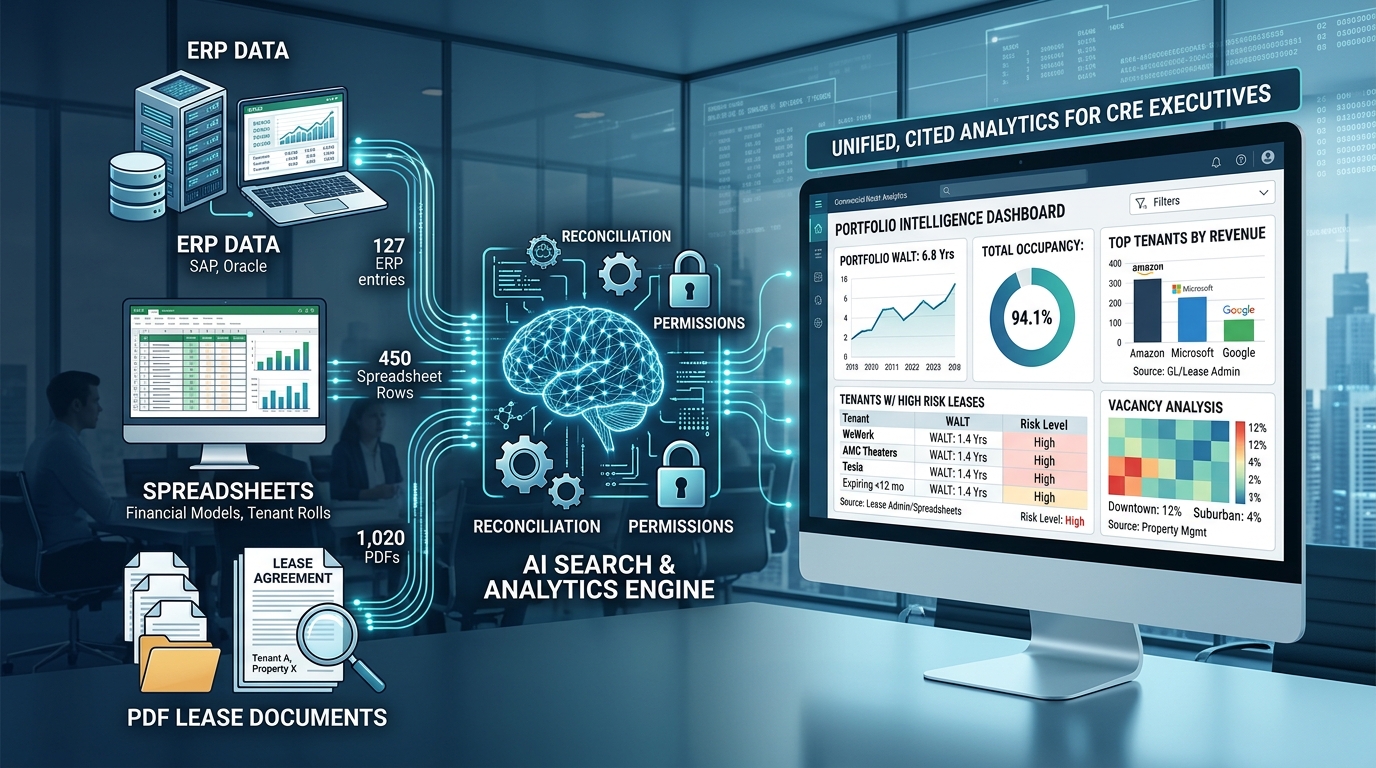
A portfolio executive asks one question: "Which properties have tenants below investment grade with leases expiring in the next 12 months, and do any of them have CapEx projects already flagged for deferral?" Answering it means touching a credit-monitoring feed, the lease-administration system, and a CapEx tracker that half the regional teams still keep in Excel. Getting one coherent answer, not three separate lists the executive has to reconcile by hand, is what cross-source AI search is supposed to do.
Most vendor claims about "searching across your data" understate how hard that actually is. Pulling matching keywords from several systems and stacking the results is not the same as answering a question that genuinely depends on all of them agreeing on what a property, a tenant, and a lease actually are. This article covers what cross-source retrieval requires structurally, walks through a worked example, and introduces a framework for evaluating whether a system is doing real reconciliation or just concatenating search results.
In this article
- Cross-source AI search only works when the system can resolve entities, align timing, and enforce permissions across sources, not just retrieve matching text from each one.
- Structured querying and document retrieval are different mechanisms, and most real CRE questions need both.
- Grain mismatch is a common, underestimated source of wrong answers.
- When two sources disagree, a well-built system should state the disagreement and cite both, not silently pick one.
- Permissions have to be enforced at query time across every source touched.
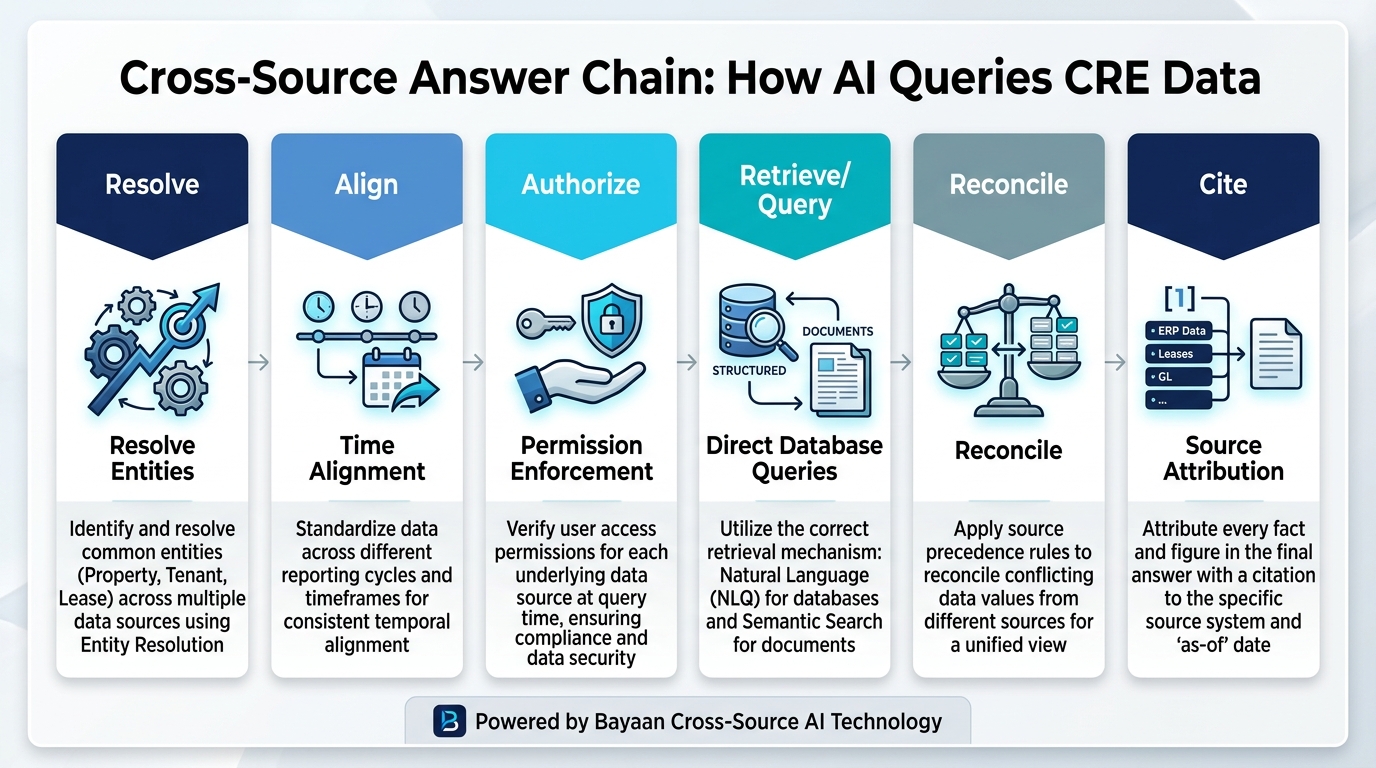
- The Cross-Source Answer Chain is Resolve → Align → Authorize → Retrieve/Query → Reconcile → Cite.
Structured querying vs. document retrieval
Commercial real estate data lives in two fundamentally different shapes, and a cross-source AI system has to handle both without treating them the same way.
Structured querying works against systems with a defined schema: a property management database, a general ledger, or a rent roll table. The system translates a natural-language question into a structured query, filters and joins rows, and returns figures that can be recalculated and audited. This is the right mechanism for questions like "What's the average WALT across the industrial portfolio?"
Document retrieval works against unstructured content: signed leases, appraisals, loan agreements, offering memos, and inspection reports. The system searches and retrieves relevant passages, typically using semantic search, and surfaces the specific clause or figure that answers the question.
The executive's question above needs both: structured data for lease-expiration dates and credit ratings, and potentially document retrieval if CapEx deferral notes live in a memo rather than a structured tracker field. A system built for only one mechanism will silently drop half the answer.
What actually breaks when you search across sources
Concatenating results from several systems is easy. Producing one answer the reader can trust is where most implementations fail.
Entity resolution
The same property, tenant, or lease has to be recognized as the same thing across systems that name it differently. Without this, a cross-source query can treat two records of the same property as unrelated, or merge two different properties that happen to share a similar name.
Time alignment
Sources update on different cadences. Property-management data may refresh daily, the GL monthly, and an appraisal quarterly or annually. A question spanning multiple sources needs to state which point in time each figure reflects.
Grain mismatch
One source may report at property level, another at unit level, and another at individual lease-line level. Aggregating across those grains without accounting for the difference produces numbers that look precise and are wrong.
Conflicting values
Two sources can both be correct and still disagree. The system needs a policy for which source takes precedence for which question, and it needs to say when it is making that call.
Permissions across sources
A user may have access to the lease system but not the fund-level financial model. A cross-source query has to enforce each source's access rules individually at query time.
Source precedence and when to keep answers separate
Not every disagreement should be resolved by picking a winner. When two sources report different values for the same fact and no precedence rule exists, a well-built system should say so explicitly rather than silently average or default to whichever source it queried first.
A reasonable pattern is to define precedence for governed conflicts, such as treating the GL as authoritative for booked NOI over an informal property spreadsheet, and return both values with their sources when no precedence rule exists.
A worked example: crossing three source types
Return to the executive's question: tenants below investment grade, with leases expiring in 12 months, cross-referenced against flagged CapEx projects.
- Credit data (structured, external feed). Query tenant credit ratings, filtering for below investment grade.
- Lease administration system (structured, internal). Cross-reference those tenants against lease-expiration dates within the next 12 months at lease-line grain.
- CapEx tracker (mixed, partially unstructured). Some regions maintain CapEx flags as structured fields; others store them in project memos requiring document retrieval.
The reconciliation step matters because the CapEx source is not uniform across the portfolio. The system must distinguish "we checked and found none" from "we don't have structured data for this region" rather than turning missing data into a false negative.
The Cross-Source Answer Chain
Use this framework to evaluate whether a system is doing real cross-source reconciliation or simply running parallel searches and stacking the output.
| Stage | What happens | What fails if skipped |
|---|---|---|
| Resolve | Match the same property, tenant, or lease across every source | Records are treated as unrelated or different entities are merged |
| Align | Establish which point in time each source reflects | Live and stale figures are silently blended |
| Authorize | Check permissions against each individual source | A user sees data they should not access |
| Retrieve/Query | Use structured query for databases and semantic retrieval for documents | The wrong mechanism produces an incomplete answer |
| Reconcile | Apply source precedence or return separate cited answers | A wrong merged number hides a disagreement |
| Cite | Attribute every figure to its source and, where relevant, as-of date | The reader cannot verify the answer |
A system that cannot account for each stage is doing parallel single-source search with a shared chat interface on top, which looks similar in a demo and behaves very differently on a real portfolio question.
Where this falls short
- Cross-source retrieval doesn't fix bad source data. If a CapEx tracker is out of date, the reconciliation layer can surface the gap but cannot manufacture missing data.
- Precedence rules require ongoing ownership. Someone must decide and periodically revisit which source wins for which metric.
- Document retrieval over legal language carries real risk if unreviewed. A retrieved lease clause is a starting point for human review, not a substitute for legal review.
- Latency is a real tradeoff. Querying multiple live sources can be slower than a single-source search.
Evaluating a cross-source AI system
- Ask a question that spans at least three source types, including at least one unstructured document source.
- Deliberately test a known disagreement between two systems and check whether the tool surfaces the conflict.
- Ask for the as-of date on every figure returned.
- Test with a user who has restricted access to one of the sources involved.
- Check whether each fact cites its specific source system.
- Ask about a region or property with known data gaps and verify that missing data is not treated as a false negative.
How Bayaan approaches cross-source CRE questions
Cross-source search is most useful when it works with the firm's existing business systems rather than requiring every source to be migrated into a new repository first. Bayaan is built around this query-time approach for commercial real estate: connecting to existing databases and returning cited answers while preserving source context and governance.
The goal is not to make every source look like one database. It is to make a multi-source question answerable without forcing the user to become the integration layer.
Turn portfolio questions into governed answers
See how Bayaan helps CRE teams connect governed business data, investigate portfolio questions, and generate trusted outputs.
Talk to Bayaan