

In this article
An asset manager pulls occupancy for a 40-property fund the morning before an investor call. The property management system says 91%. The finance team's GL-based report says 87%. Neither number is wrong. They're answering slightly different questions, using data that was never built to reconcile with each other. That gap, multiplied across leases, rent rolls, CapEx budgets, and NOI calculations, is what a commercial real estate data silo actually looks like in practice.
Silos rarely start as a technology failure. They start as a reasonable decision made by one team, at one point in time, without a shared data strategy across the portfolio. This article classifies the root causes behind CRE data silos, shows how to diagnose which ones you actually have, and walks through remediation options that don't assume every firm needs to rebuild around one central database.
Key takeaways
- A commercial real estate data silo exists whenever the same business question produces two answers that can't be automatically reconciled across systems.
- CRE silos have five distinct root causes: technical, organizational, contractual/vendor, ownership-structure, and definition silos. Each needs a different fix.
- Symptoms show up as reconciliation time before reporting, conflicting KPI values across teams, and stale or duplicated rent rolls, not as a single obvious outage.
- Identity resolution, matching the same property, tenant, or lease across systems that name them differently, is a prerequisite for integration, not a byproduct of it.
- Metric governance (agreeing what "occupancy" or "NOI" means before wiring systems together) prevents silos from reappearing after a technical fix.
- Centralizing everything into one database is one remediation path among several, and it isn't automatically the right one for every firm or every silo type.
What counts as a data silo in commercial real estate?
A commercial real estate data silo is a data set that answers a portfolio question in a way that cannot be reconciled, automatically, with the same question asked from another system. Having multiple systems isn't itself a silo. Yardi for property management, Argus for underwriting, and Excel for the investor model can coexist without creating a silo, as long as the numbers they produce can be traced back to a common source and definition.
The silo forms when that traceability breaks: when the property management system's rent roll and the loan servicer's rent roll diverge and nobody owns reconciling them, or when a regional team keeps its own CapEx tracker because the corporate system doesn't reflect how their properties actually get approved. At that point, the organization has two versions of the truth, and every downstream report inherits the ambiguity.
This distinction matters for remediation. A tool-count problem gets solved by consolidation. A reconciliation problem gets solved by identity resolution, metric governance, and clear ownership, which may or may not involve consolidating tools at all.
The five root causes of CRE data silos
Most CRE data problems get labeled "integration issues," which hides the fact that they come from structurally different sources. Treating a definition silo like a technical silo, for instance, wires two systems together that still disagree on what they're measuring.
| Silo type | What causes it | Typical CRE example |
|---|---|---|
| Technical | Systems that don't expose APIs, or export data in incompatible formats and grains | A property management export lands as a flat file with property-level totals; the finance model needs unit-level detail |
| Organizational | Teams build workflows around their own tools without a shared data owner | A regional leasing team maintains its own lease-expiration tracker because the corporate system lags real activity |
| Contractual/vendor | Third-party property managers or vendors control data access under the management agreement | A third-party PM's system is the system of record, but the owner's team only receives monthly PDF reports, not raw data |
| Ownership-structure | Funds, JVs, and co-investment vehicles keep separate books by design | A JV partner's finance team maintains NOI in their own format for their LPs, distinct from the sponsor's portfolio-wide reporting |
| Definition | The same term is calculated differently across teams or systems | "Occupancy" means physical occupancy to operations, leased occupancy to leasing, and economic occupancy to finance |
Firms that experience CRE data fragmentation typically have some combination of at least three of these five, which is why a single API project rarely resolves the whole problem. Deloitte's 2025 Commercial Real Estate Outlook found that data readiness ranks among the top obstacles firms cite when trying to scale analytics and AI, and that real estate data has historically not been standardized across the industry, which is consistent with silos forming from multiple root causes rather than one missing integration.
How silos actually show up
Silos rarely announce themselves as a system outage. They show up as friction that teams learn to work around, which is part of why they persist for years.
- Reconciliation time before every report. Someone opens the property management export, the loan spreadsheet, the valuation model, and a folder of lease PDFs, then manually stitches them into one view before a report can go out.
- Conflicting KPI values in the same meeting. Leasing reports one occupancy number, finance reports another, and the meeting spends its first ten minutes debating whose number is right instead of what to do about it.
- Stale or duplicate rent rolls. A rent roll gets exported, edited in Excel for one purpose, and never synced back, so three versions circulate with three different last-updated dates.
- Inability to answer a cross-portfolio question quickly. "Which properties have leases expiring in the next 12 months with tenants below investment grade?" requires manually cross-referencing the lease system, the rent roll, and a separate credit-tracking spreadsheet.
- Copy-paste as the integration layer. Analysts move numbers between systems by hand because no pipeline exists, which means every report carries transcription risk on top of the underlying data-quality risk.
The American Productivity and Quality Center has found that fragmented systems cost employees at least an hour every week simply searching for information. In CRE, that search time concentrates hardest in the days before quarterly and investor reporting, when several silos have to be reconciled at once under a deadline.
Identity resolution: the hidden prerequisite
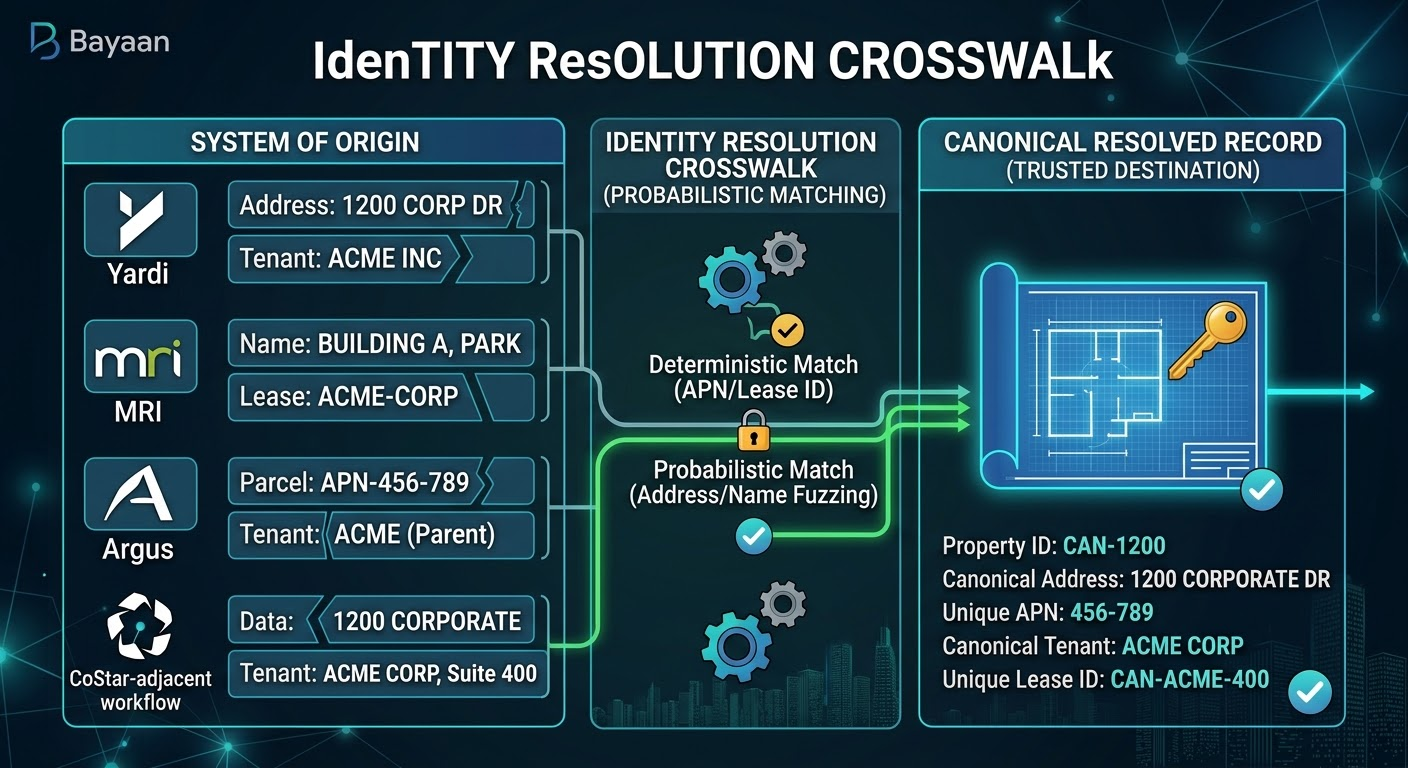
Before two systems can be integrated, they have to agree on what they're both talking about, which is harder than it sounds in a portfolio of any size. The same property might appear as "1200 Corporate Drive" in the property management system, "Building A - Corporate Park" in the loan documents, and a parcel number in the county assessor's records. The same tenant might have a different internal ID in the lease system than in the accounting system, especially after a name change, sublease, or assignment.
Identity resolution is the work of building a crosswalk, deterministic where possible (matching on APN, lease ID, or a shared unique identifier) and probabilistic where it isn't (matching on address and tenant name with a confidence threshold and human review for low-confidence matches). Skipping this step is the most common reason a well-funded integration project still produces mismatched reports: the pipes carry data correctly, but the systems on either end are describing different entities without anyone realizing it until a number looks wrong.
Metric governance: fixing definitions before fixing pipes
Even with clean identity resolution, systems can still disagree because they were built to answer different questions. Occupancy is the clearest example: physical occupancy counts occupied square footage regardless of billing status, leased occupancy counts signed leases regardless of move-in date, and economic occupancy weights by actual collected rent. All three are legitimate. None of them is "the" occupancy number until someone assigns a canonical definition for portfolio-wide reporting.
Metric governance means naming an owner for each core metric (typically finance for NOI and same-store definitions, operations for physical occupancy, leasing for lease-based metrics), documenting the calculation, and enforcing it at the point where reports get generated rather than trusting every team to apply it consistently by hand. Same-store NOI is a useful test case: firms differ on how long a property must be held and stabilized before it counts as "same-store," and that threshold has to be fixed and applied consistently, or portfolio-level trend reporting silently breaks every time the property pool changes.
Without this step, integrating the underlying systems doesn't remove the silo. It just makes the disagreement visible faster.
A worked example: reconciling a 40-property quarterly report
A sponsor managing a 40-property fund across three third-party property management platforms needs a consolidated quarterly investor report. Historically, this takes a team of three analysts most of a week.
The breakdown, mapped to root causes:
- Technical. Two of the three PM platforms export rent rolls as static PDFs, not structured files, so unit-level data has to be manually re-entered before it can be aggregated.
- Contractual/vendor. The third platform is controlled by a third-party manager whose management agreement doesn't guarantee API access, only a monthly summary report.
- Definition. One PM platform reports physical occupancy by default; the fund's investor reporting template requires economic occupancy, so every property from that platform needs recalculation.
- Ownership-structure. Six of the 40 properties sit in a joint venture, and the JV partner's finance team maintains NOI in its own template for its own LPs, on a slightly different close calendar than the sponsor's.
Fixing only the technical silo (getting structured exports from all three platforms) would still leave the definition mismatch and the JV timing gap unresolved. The team would move faster but still produce a number that doesn't match the investor template without manual adjustment. Remediation here required a data-format fix, a negotiated data-access clause for the next management agreement renewal, a documented economic-occupancy conversion rule, and an agreed reporting-close calendar with the JV partner. Three of those four fixes were organizational and contractual, not technical.
Remediation options
There's no single correct remediation path. The right one depends on which root causes are actually present and how much the organization is willing to change process versus tooling.
- Point integrations. Direct, system-to-system connections for a specific data flow (for example, PM system to accounting). Fast to build, but each new connection adds maintenance overhead, and this approach doesn't fix definition disagreements.
- Central data warehouse or lake. All source systems feed a common repository, and reports query the warehouse instead of the source systems directly. This solves technical fragmentation well but requires ongoing ETL maintenance and doesn't automatically solve contractual or ownership-structure silos where the source data itself is restricted.
- Master data management (MDM) layer. A governed layer that owns identity resolution and canonical metric definitions, sitting logically between source systems and reporting, whether or not the underlying data is physically centralized. This directly addresses identity resolution and metric governance, the two causes most other approaches skip.
- Query-time federation. Instead of moving and duplicating data into a warehouse, a governed layer queries source systems live and reconciles the answer at query time, citing where each figure came from. Bayaan for Commercial Real Estate is built around this model for its own live data sources: connecting to a firm's existing databases and answering natural-language questions with cited sources, rather than requiring every source system to be replatformed first.
- Organizational glue. Named data stewards, service-level agreements for update frequency, and a documented escalation path for definition disputes. This is often necessary alongside any technical approach, since none of the above fixes organizational or contractual silos on their own.
Altus Group's March 2026 analysis of CRE data governance describes the compounding effect plainly: without structure and context, more data just becomes more noise, compounding into fragmented files, isolated models, and disparate systems. Remediation has to address structure and ownership, not just add another system to the stack.
The Silo Root-Cause Matrix
Use this framework to prioritize remediation instead of tackling silos in whatever order they get noticed. For each silo you identify, score it across five columns.
| Source | Symptom | Business cost | Remedy | Owner |
|---|---|---|---|---|
| Third-party PM exports as PDF, not structured data | Manual re-entry every reporting cycle | Multi-day delay on quarterly reports | Renegotiate data-access clause at next management agreement renewal; require structured export | Asset management + legal |
| Occupancy defined differently by platform vs. investor template | Conflicting KPI in investor materials | Investor confidence risk, rework before every distribution | Document canonical economic-occupancy formula; enforce at report generation | Finance |
| JV partner maintains separate NOI on a different close calendar | Late or mismatched consolidated NOI | Delayed close, added reconciliation labor | Align close calendar in JV reporting agreement | Finance + JV relationship owner |
| Regional team keeps its own lease-expiration tracker | Corporate rollover-risk report misses recent activity | Missed renewal or backfill window on at-risk leases | Establish single system of record for lease events; deprecate shadow tracker | Leasing operations |
| No shared property identifier across PM, loan servicer, and county records | Manual cross-referencing on every cross-system question | Analyst time, risk of matching errors | Build identity-resolution crosswalk keyed to APN or a shared unique ID | Data/IT with asset management sign-off |
Score each row by business cost first, not by how easy the fix looks. A cheap technical fix on a low-cost silo is a worse use of a quarter than a harder organizational fix on a silo that's currently delaying every investor report.
Where this falls short
- A federation or AI query layer doesn't resolve definition disagreements on its own. It can surface that two sources disagree, and can cite each source, but someone still has to decide which definition is canonical. Skipping metric governance and expecting a query layer to silently "fix" the numbers produces a system that answers confidently from the wrong assumption.
- Contractual and ownership-structure silos often require legal and negotiation work, not engineering work. A management agreement that doesn't guarantee data access won't be solved by better software; it needs to be renegotiated at renewal, which can take a full contract cycle.
- Centralizing everything into one database isn't automatically correct, and can create a new single point of failure. For firms with JV partners who have their own reporting obligations, or third-party managers with contractual data ownership, forcing full centralization can conflict with existing agreements and concentrate risk in one system rather than removing it.
- Historical data quality issues propagate regardless of remediation approach. If a rent roll had errors five years ago, integrating it faster just delivers the same errors faster. Silo remediation doesn't substitute for a data-quality review of the underlying source.
Turn portfolio questions into governed answers
See how Bayaan helps CRE teams connect governed business data, investigate portfolio questions, and generate trusted outputs.
Talk to BayaanPrioritizing which silos to fix first
- Inventory the silos using the five root-cause categories, not a generic "data problems" list. Name each one specifically (which systems, which teams, which contract).
- Score each one on the Root-Cause Matrix by business cost, not visibility. A silo that only annoys one analyst is a lower priority than one that delays every investor report.
- Separate the technical fixes from the organizational and contractual ones. They run on different timelines and need different owners; bundling them into one "data project" usually stalls on the slowest piece.
- Fix identity resolution and metric governance before or alongside any integration project. Wiring systems together without them just moves the reconciliation problem downstream.
- Assign a named owner per fixed silo, not a team. Ownership diffused across a team tends to default back to whoever happens to notice the discrepancy that quarter.
- Revisit the inventory after any acquisition, disposition, PM change, or JV restructuring. These events are the most common source of new silos in an otherwise stable portfolio.