
In this article
Many commercial real estate professionals hear the word "chatbot" and immediately think of a website pop-up that answers leasing questions or collects contact information from prospects.
That is only one type of chatbot.
The category attracting attention inside commercial real estate today is something very different: an internal AI chatbot connected to portfolio data, financial information, occupancy metrics, lease information, budgets, and operational systems.
A website chatbot helps a visitor find information.
An internal commercial real estate AI chatbot helps employees ask questions about portfolio data.
That distinction is important because the underlying architecture, security requirements, data sources, and business value differ significantly.
The question is no longer whether a chatbot can answer a pre-written FAQ.
The question is whether a commercial real estate professional can ask:
*"Which office assets experienced the largest decline in economic occupancy this quarter?"*
and receive an answer that can be traced back to actual portfolio data.
This guide explains what commercial real estate AI chatbots are, how they work, what data they use, where they create value, and where human review remains necessary.
---
Key takeaways
- A commercial real estate AI chatbot for internal teams is fundamentally different from a public website lead-capture chatbot.
- The value of a CRE chatbot comes from data access, permissions, definitions, and citations, not from the chat interface itself.
- CRE chatbots can help users ask questions about leases, occupancy, NOI, CapEx, budgets, rent rolls, and portfolio performance.
- A trustworthy chatbot requires permissions, source traceability, and governed access to company data.
- The quality of chatbot answers depends heavily on the quality of underlying portfolio data.
- A conversational response is not automatically a validated business decision.
---
What is a commercial real estate AI chatbot?
A commercial real estate AI chatbot is a conversational interface that allows users to ask questions about commercial real estate data using natural language rather than reports, dashboards, or database queries.
Instead of searching through spreadsheets, exporting reports, or waiting for an analyst to respond, users interact through a chat interface.
Examples include:
- Which assets have the largest budget variance?
- What leases expire during the next 12 months?
- Which properties contributed most to occupancy decline?
- Show the largest CapEx overruns.
- Compare this quarter's NOI with the same quarter last year.
The key difference is that the chatbot is connected to business data rather than relying only on general internet knowledge.
In the commercial real estate context, that data may include:
- Leases
- Rent roll data
- Occupancy information
- NOI metrics
- CapEx budgets
- Property financials
- Portfolio performance information
[[SME: What is the most common first question users ask when they gain access to a CRE data chatbot for the first time?]]
---
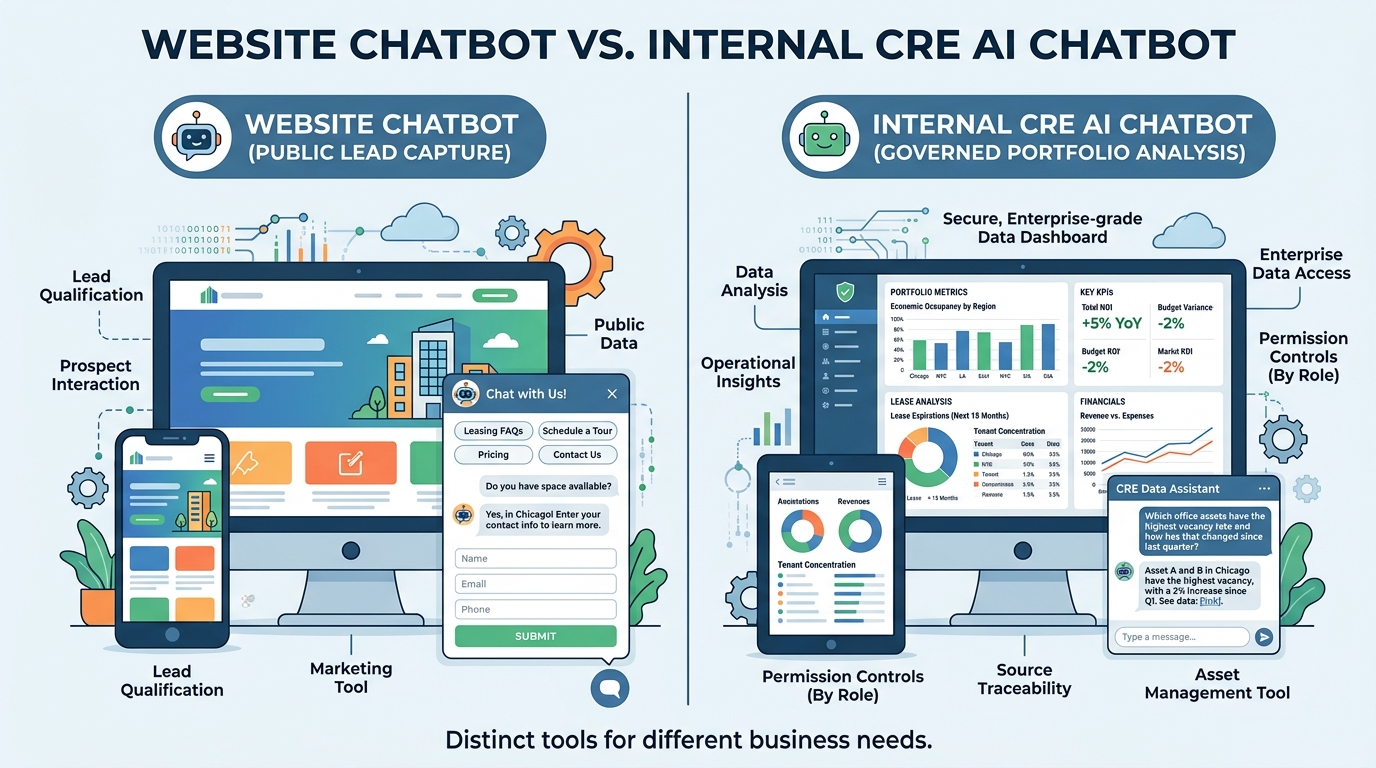
Website chatbot vs. internal CRE chatbot
Many buyers use the word chatbot when they are actually referring to two completely different systems.
| Category | Website Chatbot | Internal CRE AI Chatbot |
|---|---|---|
| Primary user | Prospect or tenant | Employee or analyst |
| Data source | FAQs, listings, forms | Portfolio and business data |
| Main job | Lead qualification | Data analysis and retrieval |
| Security model | Public access | Enterprise permissions |
| Typical question | Is suite 400 available? | Which assets have occupancy risk? |
| Buyer | Marketing or leasing | Asset management, finance, IT |
A leasing chatbot might answer:
*"Do you have office space available in Chicago?"*
An internal CRE chatbot might answer:
*"Which Chicago office assets have the highest vacancy rate and how has that changed since last quarter?"*
The technologies may appear similar to the end user.
The business problem is not.
This distinction should be established before evaluating vendors because many products marketed as AI chatbots operate in only one of these categories.
---
Why commercial real estate teams are interested in chat interfaces
Most portfolio analysis still begins with a question.
Examples include:
- Why did NOI decline?
- Which leases expire next year?
- What caused the occupancy change?
- Which properties exceeded budget?
- What does tenant concentration look like across the portfolio?
Historically, obtaining those answers often required several steps:
- Locate the correct report.
- Open the report.
- Export the data.
- Apply filters.
- Investigate the result.
- Build follow-up reports.
The workflow frequently involved multiple systems and multiple people.
A conversational interface reduces friction because the starting point becomes a question rather than a report.
That does not eliminate analysis.
It simply changes how users begin the process.
---
The question-to-answer path
When people see a chatbot answer, it can appear deceptively simple.
Behind the response, several activities are often occurring.
At a high level, a CRE AI chatbot follows a process like this:
- Understand the user's question.
- Identify relevant CRE entities and metrics.
- Apply business definitions.
- Retrieve supporting information.
- Enforce permissions.
- Generate an answer.
- Present supporting evidence.
For example:
User question
Which office properties experienced the largest occupancy decline this quarter?
The system must determine:
- What occupancy means
- Which period is "this quarter"
- Which properties qualify as office
- Which data source contains occupancy information
- Which properties the user is allowed to access
Only then can an answer be generated.
The complexity is rarely the chat interface itself.
The complexity is understanding and retrieving the correct information.
[[SME: During implementation, which CRE metric tends to require the most clarification before users consistently get expected answers?]]
---
What data can a CRE chatbot use?
The usefulness of a chatbot depends on the information available to it.
Commercial real estate organizations generate data across multiple operational areas.
Common categories include:
Lease data
Examples:
- Start dates
- Expiration dates
- Renewal options
- Tenant names
- Square footage
- Lease status
Occupancy data
Examples:
- Physical occupancy
- Leased occupancy
- Economic occupancy
- Vacancy status
- Space availability
Financial data
Examples:
- NOI
- Revenue
- Expenses
- Budget variance
- EBITDA
- Property performance
CapEx information
Examples:
- Budgeted projects
- Committed spend
- Actual spend
- Forecasts
- Project status
Portfolio information
Examples:
- Property hierarchy
- Regions
- Funds
- Asset categories
- Ownership structures
A chatbot cannot answer questions about information it cannot access.
Data readiness frequently determines success more than AI sophistication.
---
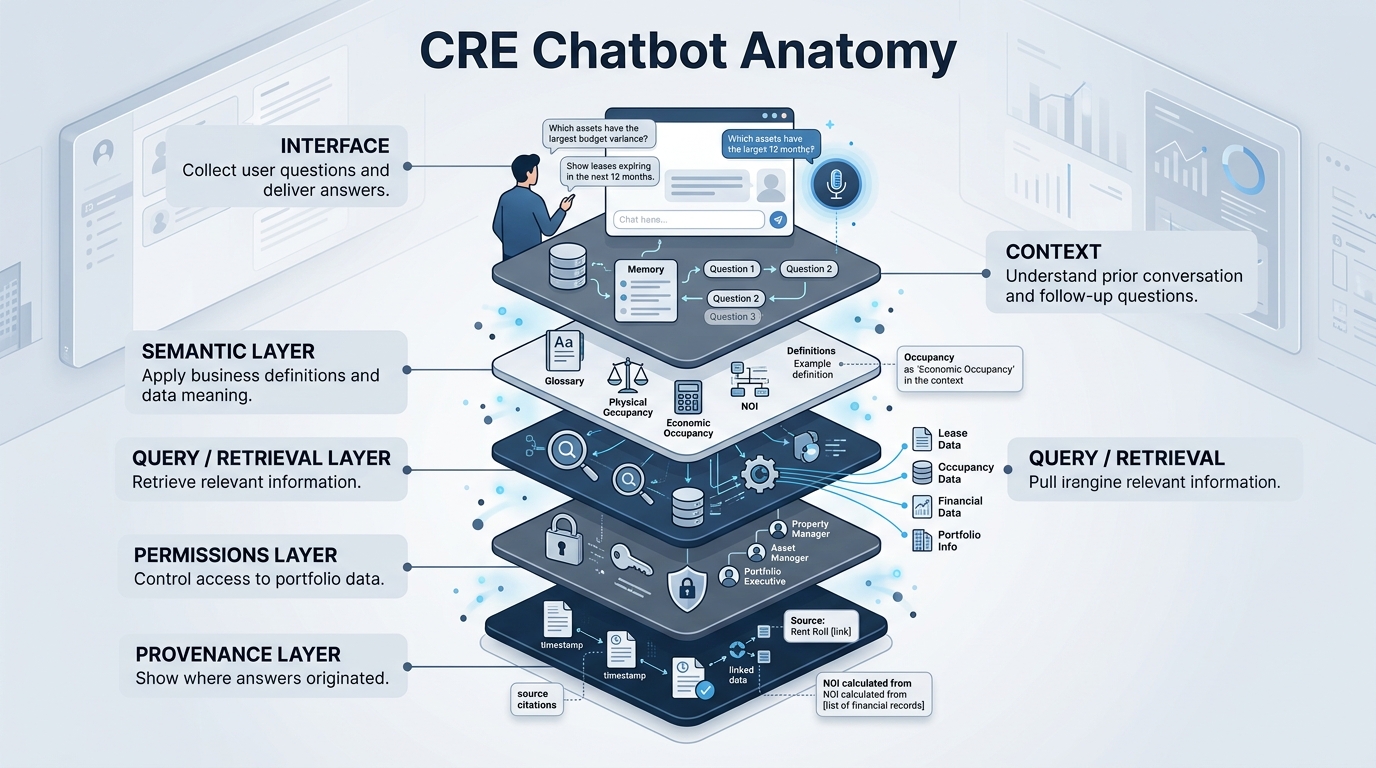
The CRE Chatbot Anatomy
Commercial real estate AI chatbots are often described as chat interfaces.
The interface is usually the least important component.
What determines success is everything operating behind the conversation.
The CRE Chatbot Anatomy
| Component | Purpose |
|---|---|
| Interface | Collect user questions and deliver answers |
| Context | Understand prior conversation and follow-up questions |
| Semantic Layer | Apply business definitions and data meaning |
| Query / Retrieval Layer | Retrieve relevant information |
| Permissions Layer | Control access to portfolio data |
| Provenance Layer | Show where answers originated |
A chatbot that lacks any one of these layers becomes significantly less useful.
For example:
A chatbot may produce fluent answers.
If it cannot explain where those answers came from, users may not trust them.
Similarly, if it retrieves accurate information without enforcing access controls, it creates operational risk.
The chat window is merely the visible part of a much larger system.
[[SME: Which layer of the CRE Chatbot Anatomy required the most effort during implementation because it behaved differently than initial expectations?]]
---
Why semantic definitions matter
Many chatbot demonstrations appear impressive because the questions are simple.
Commercial real estate data is rarely simple.
Consider the term:
Occupancy
Different organizations may use:
- Physical occupancy
- Leased occupancy
- Economic occupancy
Each produces a different result.
Now consider:
NOI
Organizations may:
- Include different revenue items
- Treat recoveries differently
- Use different period boundaries
- Apply different same-store definitions
If a chatbot does not understand which business definition applies, it can provide answers that appear correct while being operationally misleading.
The problem is not artificial intelligence.
The problem is ambiguity.
Many successful implementations spend substantial effort defining common terminology before users ever begin asking questions.
[[SME: Which commercial real estate term has generated the greatest amount of user confusion due to competing business definitions?]]
---
What happens after the first answer?
The first answer is usually not the most important part of a conversation.
The value often comes from follow-up questions.
Consider this workflow:
Question 1
Which properties experienced the largest decline in economic occupancy this quarter?
Question 2
Show only office properties.
Question 3
Which tenants moved out?
Question 4
What impact did those vacancies have on NOI?
Question 5
Generate a summary for our asset-management review.
The follow-up chain allows users to investigate without repeatedly building new reports.
This conversational style is one of the biggest workflow changes introduced by internal AI chatbots.
Users move from requesting reports to exploring data.
The distinction seems small but often changes how teams investigate portfolio performance.
---
A worked example: analyzing lease expiration exposure
Consider a portfolio containing:
- 20 office assets
- 10 industrial properties
- Multiple institutional investors
An asset manager asks:
Which leases expire during the next 18 months?
The chatbot might retrieve:
- Tenant information
- Lease expiration dates
- Square footage
- Property details
The user then asks:
Which expirations represent more than 5% of property occupancy?
The chatbot applies additional filtering.
The user asks:
Which properties have multiple large expirations occurring within the same six-month period?
Now the conversation becomes analytical.
The chatbot is helping organize information around a business question.
The final answer still requires human evaluation.
A chatbot can identify concentrated rollover exposure.
It cannot decide how the organization should respond.
That distinction remains important.
---
Why permissions matter
A commercial real estate chatbot should not operate as a universal search engine across company data.
Different users often have different access rights.
| User Type | Typical Access Requirement |
|---|---|
| Property manager | Assigned properties |
| Regional leader | Regional portfolio |
| Asset manager | Asset-specific information |
| Executive | Portfolio rollups |
| Investor relations | Approved reporting information |
| External advisor | Limited project access |
Permission controls determine:
- Which assets appear
- Which financial data is visible
- Which reports are accessible
- Which questions can be answered
Without permission enforcement, organizations risk exposing sensitive information across funds, ownership groups, regions, or teams.
Commercial real estate structures such as joint ventures, investment funds, and third-party management arrangements make these controls even more important.
---
Why source citations matter
A chatbot answer is not valuable simply because it sounds convincing.
Users need to understand where information originated.
Good conversational analytics systems help users answer questions such as:
- Which source produced this result?
- Which properties were included?
- Which filters were applied?
- Which time period was used?
- Which business definition was applied?
This process is often referred to as provenance or source traceability.
Source citations do not guarantee that the underlying data is correct.
If source systems contain errors, those errors may still appear in results.
However, citations make answers reviewable.
Users can inspect supporting evidence instead of relying solely on generated text.
[[SME: What information does a successful source citation typically need to show before users trust a chatbot-generated answer?]]
---
Common failure modes of CRE AI chatbots
Ambiguous questions
Example:
*"Show occupancy."*
The system may need clarification regarding:
- Physical occupancy
- Leased occupancy
- Economic occupancy
- Portfolio scope
- Time period
Inconsistent data definitions
Different departments may define the same metric differently.
Missing source data
Incomplete lease data, stale occupancy figures, and outdated rent rolls reduce answer quality.
Permission complexity
Ownership structures often create difficult access requirements.
Overconfidence
A response may sound authoritative even when clarification is required.
[[SME: What real-world chatbot failure taught the most important lesson about CRE data quality or governance?]]
---
Where CRE AI chatbots fall short
They do not fix bad data
If source data is inaccurate, answers may also be inaccurate.
They do not resolve business disagreements
Competing definitions still require human decisions.
They do not make investment decisions
Analysis and decision-making remain separate activities.
They do not eliminate analyst work
Complex investigations still require expertise.
They may require clarification
Ambiguous portfolio questions frequently need additional context.
---
Turn portfolio questions into governed answers
See how Bayaan helps CRE teams connect governed business data, investigate portfolio questions, and generate trusted outputs.
Talk to BayaanHow should you evaluate a CRE AI chatbot?
Data access
- Can it access relevant portfolio information?
- Can it analyze lease and occupancy data?
Definitions
- How does it handle ambiguity?
- Does it request clarification?
Governance
- Are permissions enforced?
- Are answers traceable?
User experience
- Can users ask follow-up questions?
- Is conversational context preserved?
Trust
- Can answers be validated?
- Can supporting evidence be reviewed?
---