
In this article
Commercial real estate teams rarely struggle to find questions worth asking. They struggle to get reliable answers quickly.
An asset manager notices a change in occupancy. A finance leader sees NOI below budget. An executive preparing for an investment committee meeting wants to understand which assets contributed most to quarter-over-quarter variance.
Traditionally, these questions initiate a reporting chain involving spreadsheets, analysts, dashboards, email threads, exported reports, and multiple follow-up requests. Even when the answer arrives, there is often uncertainty about where the number came from, which filters were applied, and whether everyone is using the same definition.
Conversational analytics changes the interface. Instead of navigating dashboards or writing SQL queries, users ask questions in natural language. But the real value is not the conversation itself. The value comes when the answer can be traced back to the underlying portfolio data and understood in context.
A conversational analytics platform becomes decision-useful only when users can verify the source, scope, definitions, filters, and timing behind an answer. This article explains how that process works, what a useful citation should contain, and why a cited answer is different from a merely fluent one.
Key takeaways
- Conversational analytics allows CRE teams to explore portfolio data using natural-language questions instead of dashboards or SQL.
- A useful answer must include enough information to verify where the result came from.
- A citation improves reviewability and transparency but does not automatically guarantee correctness.
- Follow-up questions can inherit incorrect assumptions if definitions are unclear.
- CRE data introduces unique challenges involving leases, occupancy definitions, effective dates, and portfolio hierarchies.
- Trustworthy conversational analytics requires both answer generation and source traceability.
What is conversational analytics in commercial real estate?
Conversational analytics is the process of querying business data through natural language and receiving answers that can be explored through additional questions.
Instead of opening multiple systems to investigate a portfolio issue, a user can ask:
"Which office assets had the largest occupancy decline during Q2?"
The system interprets the request, retrieves or queries relevant information, and returns an answer.
The critical distinction is that enterprise-grade conversational analytics should explain how the answer was produced. Without verification information, users are forced to trust the response without understanding the source data behind it.
Commercial real estate environments make verification especially important because seemingly simple metrics often contain multiple valid interpretations.
Consider occupancy:
- Physical occupancy
- Leased occupancy
- Economic occupancy
Each definition can generate dramatically different results. If a conversational system returns an occupancy figure but does not explain which definition was used, that answer may create confusion rather than clarity.
[[SME: What occupancy-related question has caused the most confusion in real CRE workflows because users intended different occupancy definitions?]]
Why conversational analytics matters to CRE teams
Most CRE organizations have already invested heavily in software and reporting infrastructure.
The challenge is not a shortage of reports.
The challenge is answering unexpected questions.
A standard dashboard can tell you that occupancy declined. It may even identify the affected property.
The next question is usually more complicated:
- Which tenants moved out?
- How much annual rent was affected?
- Were those tenants expected to renew?
- Did the decline affect budget forecasts?
- How does performance compare to similar assets?
Each new question traditionally creates another investigation cycle.
Conversational analytics compresses that cycle into a continuous dialogue.
Instead of submitting new analyst requests, users can immediately explore the next layer of context.
| Traditional Analysis Workflow | Conversational Analytics Workflow |
|---|---|
| Ask analyst for report | Ask question directly |
| Wait for output | Receive answer immediately |
| Request additional segmentation | Ask follow-up question |
| Receive updated report | Continue conversation |
| Request supporting data | Review citation and source |
| Build presentation separately | Generate deliverables afterward |
The productivity gain comes from shortening the distance between question and insight.
The trust gain comes from preserving visibility into how the answer was produced.
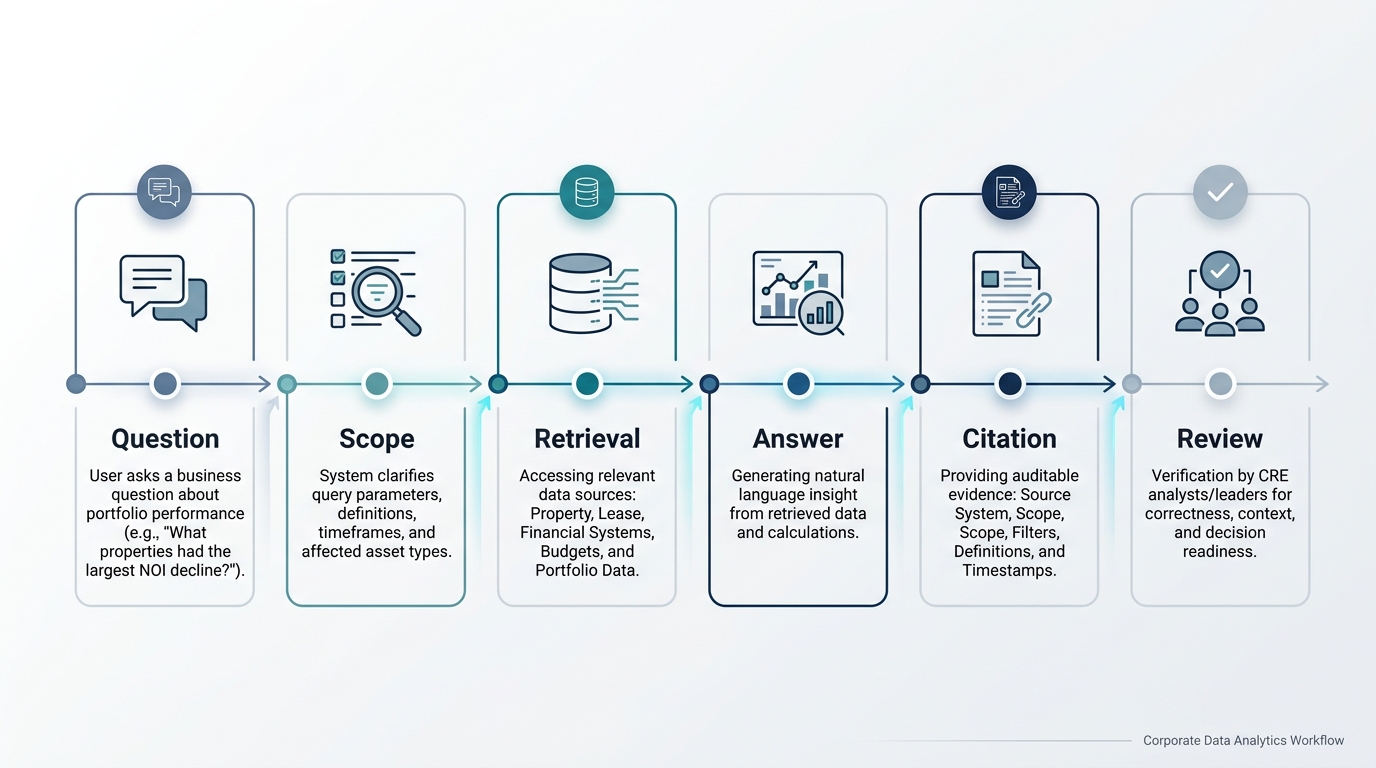
The journey from question to cited answer
A conversational answer passes through several stages before it becomes usable for a business decision.
Step 1: Business question
The process starts with a business question, not a technical query.
Example:
"Which retail properties experienced the largest NOI decline last quarter?"
The user already understands the business problem.
The system's responsibility is translating that problem into data retrieval logic.
Step 2: Scope identification
The system identifies:
- Asset type: retail
- Metric: NOI
- Time period: last quarter
- Comparison basis: largest decline
At this stage, ambiguities may still exist.
For example:
- Which NOI definition?
- Same-store only?
- Portfolio-wide?
Strong systems identify ambiguity instead of silently making assumptions.
Step 3: Data retrieval
The relevant data is collected from connected systems.
This may include:
- Property records
- Financial systems
- Portfolio databases
- Budget records
- Historical performance tables
The retrieval stage determines the evidence available for the final answer.
Step 4: Answer generation
The retrieved data is converted into a response that humans can read.
Instead of presenting raw database output, the system summarizes findings:
"Property A experienced the largest NOI decline. The decline was driven primarily by lower occupancy and reduced recovery income."
A readable answer improves usability.
A citation improves trust.
Step 5: Citation generation
A useful citation records how the answer was produced.
This stage is often what separates enterprise analytics from generic AI experiences.
The problem with answers that have no citation
Imagine receiving this response:
"Portfolio occupancy is 89.7%."
Several important questions remain unanswered.
- Which properties were included?
- What occupancy definition was used?
- When was the data collected?
- Were under-construction assets excluded?
- Which source system supplied the data?
Without those details, users cannot validate the result.
A fluent answer may appear credible while lacking essential context.
This becomes especially problematic when numbers are included in:
- Asset reviews
- Executive briefings
- Board materials
- Investor communications
- Budget discussions
Conversational analytics should reduce investigation effort, not eliminate transparency.
A complete CRE example: From question to evidence
Consider this question:
"Which assets contributed most to NOI decline during the first half of the year?"
A trustworthy workflow might look like this:
Question
Which assets contributed most to NOI decline during the first half of the year?
Returned answer
Three office assets generated most of the portfolio decline:
- Asset A
- Asset B
- Asset C
Combined, they represented the majority of negative NOI variance during the period.
Supporting context
The answer identifies:
- Revenue impact
- Expense impact
- Occupancy changes
- Time period used
Source trail
The system records:
- Source database
- Portfolio filter
- NOI definition
- Time range
- Data extraction timestamp
At this stage, a reviewer can independently understand how the result was produced instead of treating it as an unexplained AI conclusion.
[[SME: Describe a real CRE question that demonstrated the value of source-backed answers versus a traditional dashboard or static report.]]
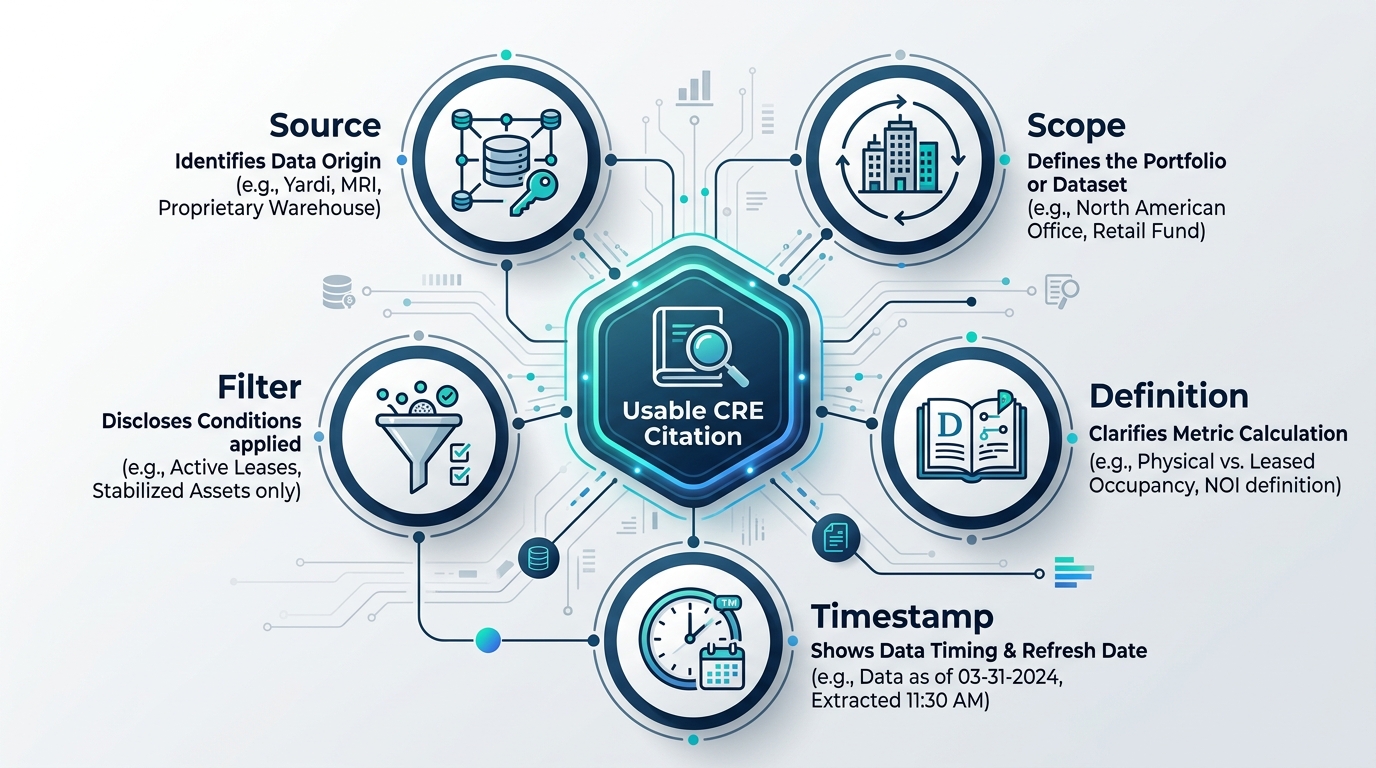
The Five Components of a Usable Citation
A useful citation is more than a hyperlink to a source system.
For conversational analytics to support real estate decisions, the citation must give reviewers enough context to reproduce and challenge the answer.
This article uses the following framework:
| Component | What It Answers |
|---|---|
| Source | Where did the data come from? |
| Scope | What portfolio, asset set, or records were included? |
| Filter | What conditions limited the result? |
| Definition | What business definition was applied? |
| Timestamp | When was the data retrieved or valid? |
Together, these five elements help users understand how a result was produced instead of blindly accepting the output.
1. Source
Every answer should identify its originating data source.
Examples might include:
- Property management database
- Lease-management platform
- Finance database
- Budget repository
- Data warehouse
Without source identification, users cannot validate the underlying evidence.
2. Scope
Scope explains what was included.
For example:
Retail portfolio only
is significantly different from:
Entire North American portfolio
The answer may be correct within its scope while appearing incorrect when interpreted more broadly.
3. Filter
Many answers rely on hidden filtering conditions.
Examples:
- Active leases only
- Stabilized assets only
- Excluding redevelopment projects
- Excluding sold properties
A difference in filter logic can completely change the final result.
4. Definition
Commercial real estate contains numerous metrics with multiple accepted definitions.
Examples include:
- Occupancy
- NOI
- Leasing spreads
- Tenant concentration
- WALT
A citation should clarify which definition generated the answer.
5. Timestamp
Portfolio data changes constantly.
A useful answer should indicate:
- Data effective date
- Reporting period
- Refresh time
- Retrieval time
Without timing information, users may unknowingly compare current and historical figures.
[[SME: What source-related detail tends to matter most when CRE users challenge an answer during review?]]
Citation does not equal correctness
One of the biggest misconceptions in AI analytics is assuming that citations prove an answer is correct.
They do not.
A citation demonstrates traceability.
Correctness still depends on:
- Source-data quality
- Metric definitions
- Business rules
- Permissions
- Query logic
Consider a lease database containing incorrect expiration dates.
A conversational assistant may produce an answer with perfect citations.
The answer would still be wrong because the underlying data is wrong.
The citation simply allows reviewers to identify and investigate the issue.
This distinction matters because organizations sometimes evaluate AI outputs as if citations eliminate all risk.
They do not.
Citations reduce uncertainty by making answers reviewable and reproducible.
How follow-up questions can inherit bad assumptions
Conversational interfaces preserve context.
This improves usability but also creates new risks.
Consider this conversation:
Question 1
Which assets have declining occupancy?
Answer
Three office assets show occupancy declines.
Question 2
Which tenants caused the decline?
Question 3
How much NOI was affected?
All three questions depend on the same occupancy interpretation established by the first answer.
If the original occupancy calculation used leased occupancy when the user intended economic occupancy, every follow-up may continue building on the wrong assumption.
The conversation remains logically consistent while producing an analysis pathway the user never intended.
This is why enterprise conversational analytics should expose assumptions rather than hiding them.
Strong systems help users see:
- Metric definitions
- Time periods
- Portfolio scope
- Calculation methods
before the conversation progresses too far.
Conversation trust versus answer trust
Many modern AI systems are excellent conversational experiences.
That does not automatically mean they are trustworthy analytics systems.
There is an important distinction between:
Conversation trust
The answer sounds fluent.
The language appears professional.
The result feels reasonable.
Answer trust
The result can be traced.
The supporting evidence is visible.
The reviewer can verify the source.
The assumptions are disclosed.
The difference becomes critical when discussing:
- Portfolio performance
- Asset reviews
- Budget variance
- Board reporting
- Investment committee decisions
A smooth conversation can improve productivity.
A cited answer improves accountability.
The strongest systems provide both.
The reconstruction test
One practical way to evaluate conversational analytics platforms is through what can be called the Reconstruction Test.
Ask a simple question:
Can another qualified user reproduce the answer using the information provided?
If the answer is no, the result may not be sufficiently transparent for enterprise decision-making.
A reviewer should ideally understand:
- Which source was used.
- Which records were included.
- Which filters were applied.
- Which definitions were used.
- When the data was retrieved.
If those elements cannot be reconstructed, the answer may be difficult to audit later.
This becomes increasingly important when organizations rely on AI outputs inside investor communications, operational reviews, and strategic planning workflows.
The Cited Answer Review Checklist
Before relying on a conversational answer, review the following questions:
| Question | Why It Matters |
|---|---|
| Is the source identified? | Confirms origin of the data |
| Is portfolio scope clear? | Prevents interpretation mistakes |
| Are filters disclosed? | Reveals hidden assumptions |
| Is the metric defined? | Prevents definition conflicts |
| Is timing visible? | Ensures freshness and relevance |
| Can the result be reproduced? | Supports review and audit |
| Does the answer align with known business context? | Helps identify potential errors |
Teams do not need to manually validate every answer.
They do need a repeatable method for validating important answers before those results influence business decisions.
Where conversational analytics falls short
Conversational analytics is valuable, but it has limitations.
Source-system errors remain source-system errors
If lease records, GL data, or portfolio mappings contain mistakes, those mistakes can appear in conversational answers.
Metrics may have competing definitions
Occupancy, NOI, retention rates, and leasing metrics can differ across firms and business units.
A system cannot resolve organizational disagreement automatically.
Context accumulation can amplify mistakes
Incorrect assumptions introduced early in a conversation can affect subsequent analysis.
Human judgment remains essential
Asset strategy, investment decisions, market interpretation, and negotiation outcomes still require human expertise.
Citations improve transparency, not truth
A cited answer can still be wrong if the underlying evidence is incorrect.
Understanding this distinction is essential for responsible adoption.
How to evaluate a conversational analytics platform
Many vendors can demonstrate impressive answers in a controlled example.
A stronger evaluation approach is to test whether the platform can maintain transparency when questions become more complex.
The following evaluation criteria are particularly useful for commercial real estate teams.
| Evaluation Area | Questions to Ask |
|---|---|
| Traceability | Can every answer be traced back to source data? |
| Definitions | Are metric definitions visible to users? |
| Scope Transparency | Can users see what assets and records were included? |
| Filters | Are exclusion and inclusion criteria disclosed? |
| Freshness | Does the platform show data timing and retrieval context? |
| Follow-Up Accuracy | Do follow-up questions preserve context appropriately? |
| Reproducibility | Can another user recreate the answer? |
| Auditability | Is there a record of what question was asked and how it was answered? |
A vendor demonstration should extend beyond simple retrieval questions.
Ask questions that expose common CRE ambiguities:
- Which occupancy definition was used?
- Which assets were excluded?
- How were sold assets handled?
- Which reporting period was selected?
- Can the answer be reproduced by another analyst?
The discussion often reveals more about trustworthiness than the original answer itself.
Turn portfolio questions into governed answers
See how Bayaan helps CRE teams connect governed business data, investigate portfolio questions, and generate trusted outputs.
Talk to BayaanA practical conversational analytics demo script
Instead of evaluating a platform with isolated questions, evaluate a complete investigation workflow.
Question 1
Which office properties experienced the largest decline in NOI during the past quarter?
Question 2
Break down the decline by revenue versus expenses.
Question 3
How much of the change was occupancy-related?
Question 4
Which tenants contributed most to the occupancy decline?
Question 5
Show the sources used to produce the analysis.
This sequence tests more than answer generation.
It tests:
- Context retention
- Analytical depth
- Drill-down capability
- Source transparency
- Citation quality
A system that performs well on these questions is generally much closer to supporting real business workflows.