
In this article
title: AI Chatbot vs. BI Dashboard for Commercial Real Estate slug: ai-chatbot-vs-bi-dashboard-cre meta_title: AI Chatbot vs BI Dashboard for CRE | Bayaan meta_description: Compare AI chatbots and BI dashboards for commercial real estate. Learn when each works best and why many CRE teams need both. primary_keyword: ai chatbot vs bi dashboard secondary_keywords:
- commercial real estate analytics
- AI for commercial real estate
- CRE business intelligence
- real estate reporting software
- AI data analytics
- portfolio analytics
search_intent: commercial-investigation audience: commercial real estate executives, asset managers, property managers, analysts funnel_stage: MOFU word_count_target: 2200 pillar: Commercial Real Estate Data Analytics internal_links_out:
- /commercial-real-estate-data-analytics-complete-guide/
- /ai-reporting-commercial-real-estate/
- /enterprise-ai-commercial-real-estate/
- /commercial-real-estate-data-analytics-tools/
schema:
- Article
- FAQPage
last_updated: 2026-08-24 ---
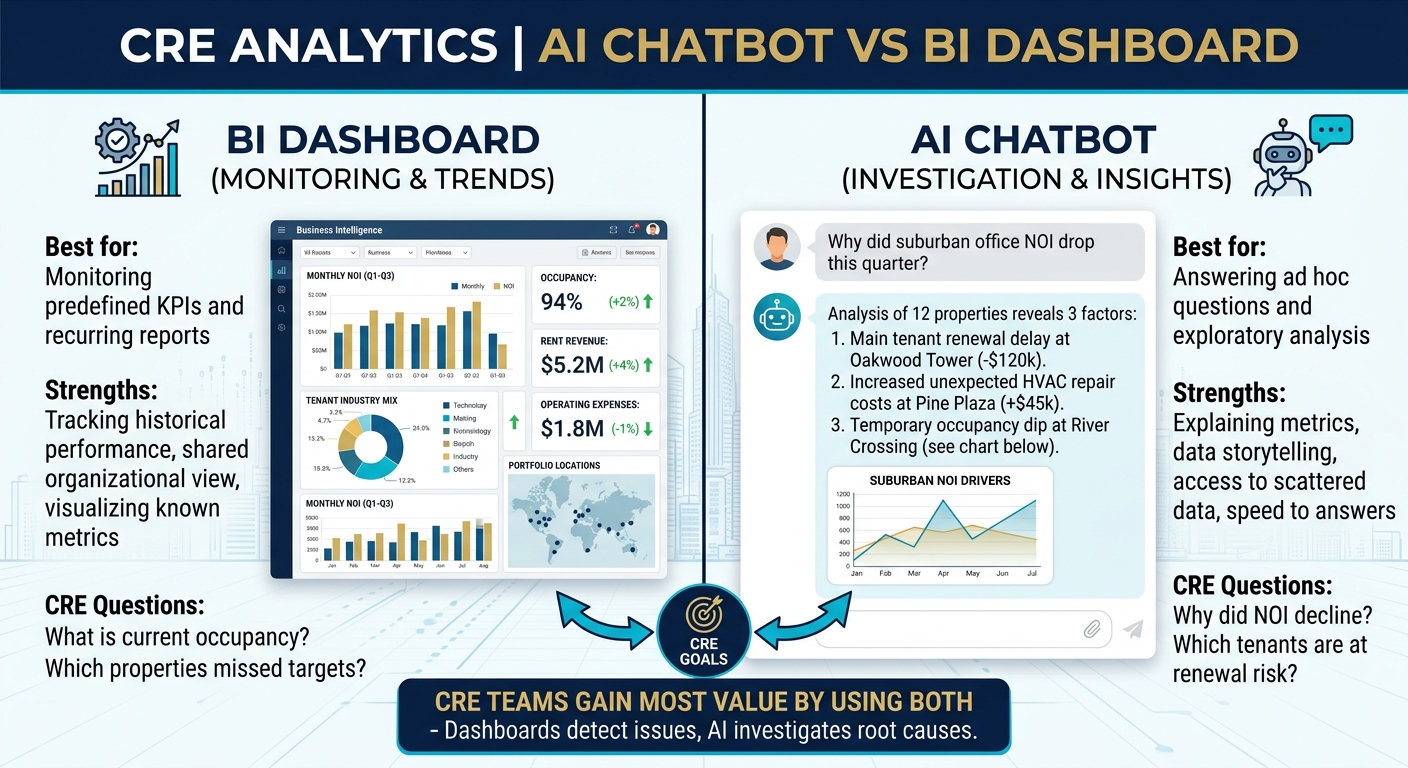
Commercial real estate teams increasingly face a choice between AI chat interfaces and traditional BI dashboards. The reality is that this is usually the wrong question. AI chatbots and BI dashboards solve different problems. A BI dashboard helps users monitor known metrics. An AI chatbot helps users investigate unknown questions. The most effective CRE organizations use both.
If your team tracks occupancy, NOI, leasing activity, capital projects, and portfolio performance, understanding the strengths and weaknesses of each approach can help you invest in technology that improves decisions rather than creating another reporting layer.
Throughout this guide, we'll compare AI chatbots and BI dashboards across common commercial real estate workflows and explain where each delivers the most value.
---
Key Takeaways
- BI dashboards are best for monitoring predefined KPIs and recurring reports.
- AI chatbots are best for answering ad hoc questions across large data sets.
- Dashboards show what is happening; AI helps explain why it is happening.
- CRE teams often struggle because portfolio knowledge is scattered across spreadsheets, reports, leases, and emails.
- The strongest technology strategy combines governed AI with structured dashboard reporting.
---
What Is the Difference Between an AI Chatbot and a BI Dashboard?
An AI chatbot is a natural-language interface that allows users to ask questions about business data and receive answers in conversational language.
A BI dashboard is a visual reporting environment that presents predefined charts, KPIs, scorecards, and reports built around specific business metrics.
The key distinction is simple:
| Capability | AI Chatbot | BI Dashboard |
|---|---|---|
| Natural language questions | Yes | No |
| Fixed KPI monitoring | Partial | Yes |
| Ad hoc analysis | Yes | Limited |
| Visual trend reporting | Limited | Yes |
| Executive scorecards | Limited | Yes |
| Investigative analytics | Yes | Limited |
| Business-user accessibility | Yes | Depends on complexity |
| Data storytelling | Yes | Limited |
A dashboard requires someone to decide in advance which metrics matter. An AI chatbot allows users to explore questions that were not anticipated when reports were created.
---
How Commercial Real Estate Teams Use BI Dashboards
BI dashboards became popular because commercial real estate portfolios generate large volumes of operational and financial data.
Typical dashboard metrics include:
- Occupancy rates
- Leasing activity
- Rental revenue
- NOI trends
- Property expenses
- Capital project tracking
- Tenant retention
- Investment performance
A dashboard provides a shared view of portfolio performance across the organization.
For example, an asset management team may review a monthly dashboard showing:
- Occupancy by property
- Leasing velocity
- Revenue growth
- Operating expenses
- Delinquency rates
Because these metrics are reviewed regularly, dashboards are highly effective.
The challenge appears when stakeholders need information that was not included in the dashboard design.
---
Where BI Dashboards Begin to Break Down
BI dashboards are excellent for recurring questions.
They are less effective for exploratory analysis.
Consider a CRE executive who asks:
Which suburban office properties experienced declining occupancy after major tenant renewals, and what common factors were present?
Most dashboards are not designed to answer a question like this directly.
The user may need to:
- Open multiple reports.
- Export data.
- Combine spreadsheets.
- Consult analysts.
- Create custom visualizations.
The answer may eventually emerge, but the process is often slow.
This challenge becomes more significant as portfolios grow and data sources multiply.
---
How AI Chatbots Change CRE Analytics
AI chatbots allow business users to interact with portfolio data using natural language.
Instead of navigating reports, users ask questions directly.
Examples include:
- What was EBITDA by property last quarter?
- Which properties have the highest year-over-year expense growth?
- Show leases expiring within the next six months.
- Which tenants occupy more than 20,000 square feet across multiple locations?
- What changed in occupancy last month?
The system interprets the question, retrieves relevant information, and generates a response.
For many users, this removes the dependency on analysts for routine questions.
---
AI Chatbots Are Not Just Faster Search
Many executives initially assume AI chat is simply a more sophisticated search tool.
The real benefit is reasoning across multiple data sources.
Commercial real estate information often exists across:
- Lease systems
- Property management software
- Financial databases
- Excel workbooks
- Investor reports
- Operational documents
- Meeting notes
A modern AI workspace can pull information from multiple sources and present a unified answer.
This reduces the time spent locating information before analysis can begin.
---
Dashboard Question vs AI Question
The difference becomes easier to understand when viewed through real commercial real estate scenarios.
| Business Question | Dashboard | AI Chatbot |
|---|---|---|
| What's our current occupancy rate? | Excellent | Good |
| Which buildings missed NOI targets? | Excellent | Good |
| Why did Building A's NOI decline? | Limited | Excellent |
| Which tenants might be at renewal risk? | Limited | Excellent |
| Summarize portfolio performance for investors. | Limited | Excellent |
| Track quarterly KPIs. | Excellent | Limited |
| Explore new business questions. | Limited | Excellent |
This illustrates why many organizations eventually use both.
Dashboards monitor.
AI investigates.
---
A Real CRE Example
Imagine an investment firm overseeing twenty office, industrial, and life-sciences properties.
A BI dashboard quickly reveals:
- Occupancy decreased 2%.
- NOI declined 4%.
- Leasing activity slowed.
Those findings are useful.
The next question becomes:
Why?
An AI-enabled analytics environment could help answer:
- Which properties drove the decline?
- Which tenants moved out?
- Which leases expired?
- Were capital projects delayed?
- Did operating expenses increase unusually?
These are investigative questions rather than monitoring questions.
That distinction defines the difference between dashboarding and AI.
---
Governance Matters More Than Interface Design
Many CRE leaders focus on user experience when comparing dashboards and AI.
The more important consideration is governance.
Commercial real estate organizations handle sensitive information including:
- Financial performance
- Tenant records
- Lease agreements
- Acquisition data
- Investment reports
- Development plans
Any AI implementation must include:
- Access controls
- Audit trails
- Data permissions
- Source citations
- Workspace governance
Without governance, an AI chatbot may create compliance risks even if it improves productivity.
This is one reason many enterprises prefer governed AI workspaces rather than consumer AI applications.
---
When a BI Dashboard Is the Better Choice
A BI dashboard is often the right solution when:
- Metrics rarely change
- Reports are reviewed regularly
- Compliance requires standardized reporting
- Visual monitoring is important
- Board reporting follows a fixed format
Typical examples include:
- Monthly asset management reviews
- Occupancy scorecards
- Investor reporting packages
- Property operations reporting
- Capital expenditure tracking
The dashboard provides consistency and repeatability.
---
When an AI Chatbot Is the Better Choice
An AI chatbot is often the stronger choice when:
- Users ask different questions every day
- Data exists across multiple systems
- Analysts spend time answering repetitive requests
- Executives need immediate insights
- Teams create reports manually
Examples include:
- Portfolio investigations
- Investment due diligence
- Lease analysis
- Executive briefings
- Research projects
- Investor Q&A preparation
Here, flexibility matters more than standardized reporting.
---
Turn portfolio questions into governed answers
See how Bayaan helps CRE teams connect governed business data, investigate portfolio questions, and generate trusted outputs.
Talk to BayaanThe Future Is AI Plus BI, Not AI Instead of BI
The industry conversation often frames AI as a replacement for dashboards.
Most organizations discover the opposite.
Dashboards remain highly effective for operational visibility.
AI adds a conversational layer that makes underlying data easier to explore and understand.
A common future-state workflow looks like this:
- Dashboard identifies an issue.
- User asks follow-up questions through AI.
- AI explains the drivers behind the metric.
- User generates reports or presentations from the results.
- Leadership receives both KPI tracking and deeper analysis.
This approach combines monitoring, investigation, and communication into a single analytics ecosystem.
---