

In this article
title: Commercial Real Estate AI vs. ChatGPT: What's the Difference? slug: commercial-real-estate-ai-vs-chatgpt meta_title: Commercial Real Estate AI vs ChatGPT | Bayaan meta_description: Compare commercial real estate AI platforms and ChatGPT. Learn the differences in data access, governance, accuracy, and CRE workflows. primary_keyword: commercial real estate ai vs chatgpt secondary_keywords:
- AI for commercial real estate
- commercial real estate AI platform
- enterprise AI for CRE
- ChatGPT for real estate
- CRE analytics AI
- real estate AI software
search_intent: commercial-investigation audience: commercial real estate executives, asset managers, acquisitions teams, analysts funnel_stage: MOFU word_count_target: 2200 pillar: Enterprise AI for Commercial Real Estate internal_links_out:
- /commercial-real-estate-data-analytics-complete-guide/
- /enterprise-ai-commercial-real-estate/
- /ai-chatbot-vs-bi-dashboard-cre/
- /ai-reporting-commercial-real-estate/
- /commercial-real-estate-data-analytics-tools/
internal_links_in:
- /commercial-real-estate-data-analytics-complete-guide/
- /enterprise-ai-commercial-real-estate/
- /ai-reporting-commercial-real-estate/
schema:
- Article
- FAQPage
last_updated: 2026-08-24 ---
Commercial real estate AI and ChatGPT are often discussed as if they are the same thing, but they solve different problems. ChatGPT is a general-purpose AI assistant designed to work across many subjects. Commercial real estate AI platforms are specialized systems built around portfolio data, lease information, property operations, investment workflows, and governance requirements. By the end of this article, you'll understand when ChatGPT is useful, when a CRE-specific AI platform becomes necessary, and why many organizations ultimately use both.
Organizations evaluating AI for asset management, acquisitions, leasing, property operations, and investor reporting often discover that the real question is not whether AI is valuable. The question is whether a general-purpose AI assistant can safely and accurately work with commercial real estate data.
For a broader overview of portfolio analytics, see our pillar guide on Commercial Real Estate Data Analytics.
---
What Is the Difference Between Commercial Real Estate AI and ChatGPT?
Commercial real estate AI is an AI system designed around property, lease, financial, and operational data used by commercial real estate teams.
ChatGPT is a general-purpose conversational AI assistant designed to answer questions, generate content, and assist with a wide variety of tasks across industries.
The biggest difference is data access and context.
A CRE AI platform is typically connected to organization-specific information such as:
- Lease portfolios
- Occupancy data
- Financial reports
- Asset management systems
- Capital project records
- Property documents
- Investor materials
By default, ChatGPT does not inherently know any of this information.
Extractable Definition
Commercial real estate AI is an enterprise AI system that analyzes property, financial, lease, and portfolio data to support commercial real estate decision-making.
---
Why General AI Tools Often Struggle with CRE Workflows
General AI tools are highly capable when answering broad industry questions.
The challenge appears when teams need answers based on their own portfolio.
For example:
Which tenant leases greater than 25,000 square feet expire within the next eighteen months, and which assets would be most exposed if those tenants do not renew?
This type of question requires access to company-specific data.
Without access to lease records and portfolio information, even the most advanced general-purpose AI tools cannot produce a reliable answer.
The issue is not intelligence.
The issue is data availability.
---
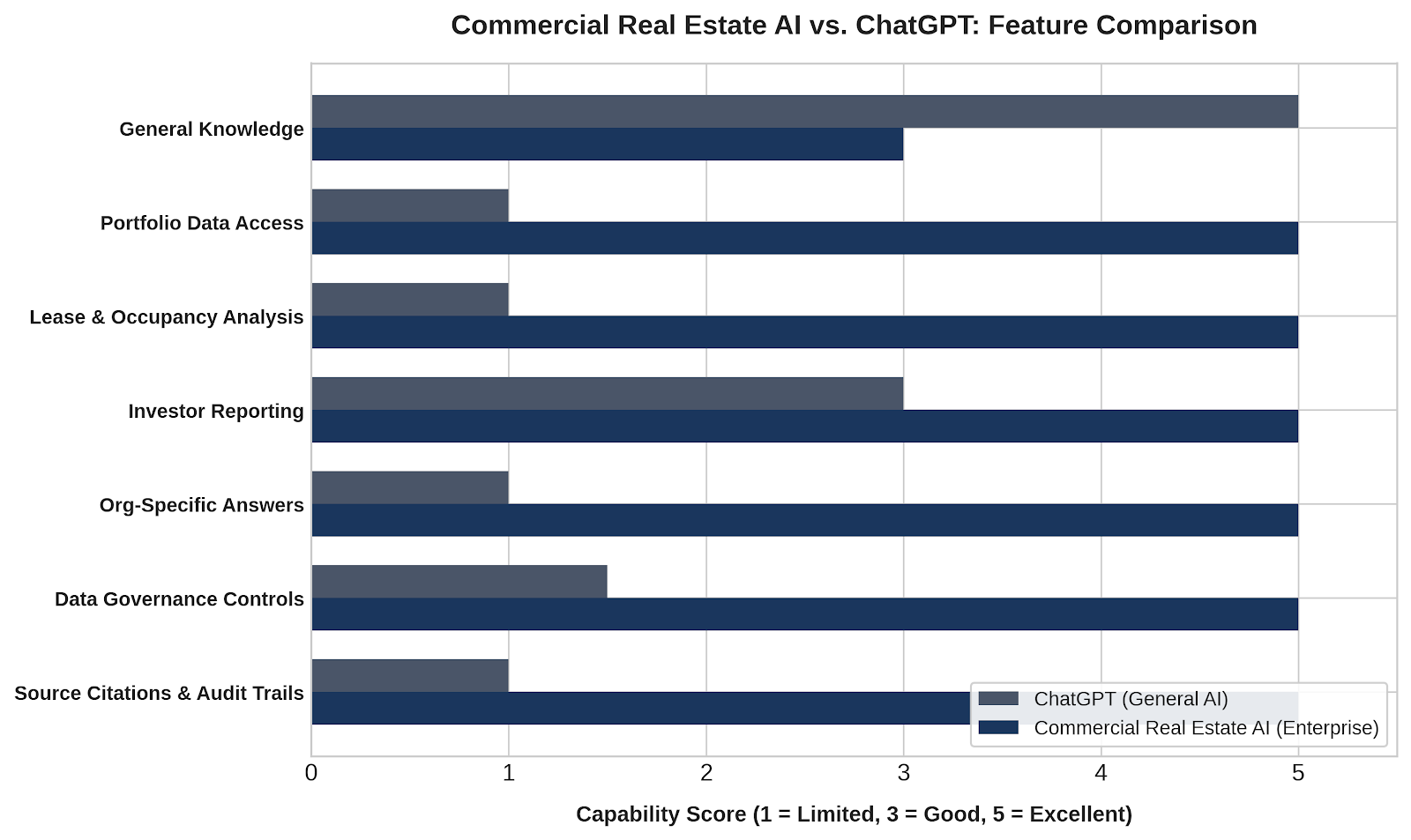
Commercial Real Estate AI vs. ChatGPT Feature Comparison
| Capability | ChatGPT | Commercial Real Estate AI |
|---|---|---|
| General knowledge questions | Excellent | Good |
| Portfolio data access | Limited | Excellent |
| Lease analysis | Limited | Excellent |
| Occupancy analysis | Limited | Excellent |
| Investor reporting | Good | Excellent |
| Organization-specific answers | Limited | Excellent |
| Data governance controls | Varies | Excellent |
| Source citations | Limited | Excellent |
| Audit trails | Limited | Excellent |
| Portfolio intelligence | Limited | Excellent |
This comparison highlights a common misconception.
Commercial real estate AI platforms are not competing against ChatGPT's reasoning ability. They are competing on access to enterprise data and governance.
---
What Happens When a CRE Team Uses ChatGPT Alone?
Many commercial real estate firms begin by experimenting with ChatGPT.
Typical uses include:
- Drafting email communications
- Summarizing meeting notes
- Creating investor presentation outlines
- Brainstorming acquisition questions
- Writing market analysis summaries
These are valuable use cases.
The limitations appear when users ask questions requiring access to internal information.
Examples include:
- Which properties missed NOI targets last quarter?
- What capital projects are behind schedule?
- Which leases present the greatest renewal risk?
- Which assets generated the highest EBITDA growth?
Without portfolio access, ChatGPT cannot verify these answers.
An analyst must manually gather the data first.
---
Where Commercial Real Estate AI Creates the Most Value
Commercial real estate AI platforms create the most value when they sit directly on top of portfolio data.
Instead of asking generic questions, users can ask organization-specific questions such as:
- What was occupancy by property last month?
- Which tenants generated the most revenue growth?
- Which industrial properties experienced the highest operating expense increases?
- Show all lease expirations by region.
The platform retrieves actual business data rather than relying solely on general knowledge.
This significantly reduces time spent searching for information.
---
Governance Is the Biggest Difference
For enterprise CRE organizations, governance often matters more than AI capabilities.
Commercial real estate firms manage:
- Confidential leases
- Acquisition strategies
- Investor communications
- Financial performance
- Tenant information
- Property valuations
Any AI system used within the organization must control who can access that information.
Governance Requirements
| Requirement | ChatGPT | Enterprise CRE AI |
|---|---|---|
| Role-based access | Limited | Yes |
| Data permissions | Limited | Yes |
| Source citations | Limited | Yes |
| Audit logging | Limited | Yes |
| Workspace controls | Limited | Yes |
| Portfolio-level security | Limited | Yes |
An enterprise AI platform is designed to operate inside organizational rules.
That distinction becomes increasingly important as adoption grows.
---
A Commercial Real Estate Example
Consider an asset manager responsible for a life-sciences real estate portfolio.
The asset manager needs an answer to the following question:
Which properties experienced declining occupancy after major lease rollovers, and what factors contributed to the decline?
Using a traditional workflow, the process might require:
- Pulling lease data.
- Reviewing occupancy records.
- Comparing historical performance.
- Building spreadsheets.
- Preparing a summary.
A commercial real estate AI platform could potentially retrieve the data and summarize the findings directly.
ChatGPT could help explain the results once the information is supplied, but it cannot automatically know the organization's portfolio performance unless connected to that data.
---
Can ChatGPT Still Be Useful for Commercial Real Estate?
Absolutely.
ChatGPT remains useful across many CRE workflows.
Examples include:
Market Research
- Understanding industry concepts
- Exploring investment terminology
- Researching property sectors
Content Creation
- Investor presentation drafts
- Internal communications
- Marketing materials
Knowledge Work
- Meeting summaries
- First-draft reporting
- Brainstorming questions
Process Support
- Due diligence checklists
- Lease review frameworks
- Property evaluation templates
The important distinction is that ChatGPT becomes more powerful when combined with verified business information.
---
Why Many Organizations End Up Using Both
The strongest commercial real estate AI strategies rarely involve choosing one tool over another.
Instead, organizations combine:
General-Purpose AI
Used for:
- Writing
- Research
- Ideation
- Communication
Commercial Real Estate AI
Used for:
- Portfolio analysis
- Asset management intelligence
- Lease insights
- Investor reporting
- Operational decisions
Together, they provide both reasoning and business context.
This is increasingly becoming the preferred operating model for enterprise organizations.
---
Turn portfolio questions into governed answers
See how Bayaan helps CRE teams connect governed business data, investigate portfolio questions, and generate trusted outputs.
Talk to BayaanWhen Commercial Real Estate AI Is the Wrong Choice
Commercial real estate AI is not always the right investment.
Organizations with:
- Very small portfolios
- Minimal reporting requirements
- Limited operational complexity
- Few users requiring access
may not immediately benefit from dedicated enterprise AI platforms.
Similarly, if portfolio data is fragmented, outdated, or poorly governed, adding AI often exposes underlying data problems rather than solving them.
A useful rule of thumb is this:
AI amplifies existing processes.
Well-organized data produces better outcomes than poorly maintained data.
---