
In this article
The first question a security review usually asks about a new AI tool is whether it trains on the company's data. It's a reasonable question, and it's also not the one that determines whether the system is actually safe to point at portfolio financials, lease terms, and investor data. A vendor can answer "no" to training-data questions and still leave gaps in permission enforcement, data location, audit coverage, or how it handles a malicious instruction hidden inside an uploaded document.
This article maps the full set of controls a CRE organization needs to evaluate before trusting an AI system with portfolio data: deployment boundaries, access enforcement, provenance, audit, model routing, and incident response. It includes a framework for organizing that evaluation and a vendor checklist to use during review. Deeper technical detail on chatbot security architecture, source-citation governance, and RBAC design lives in the articles this one leads to.
Key takeaways
- Enterprise AI risk in CRE is not solved by asking whether a vendor trains models on customer data; permission enforcement, data location, provenance, auditability, and operational governance determine whether a system is actually safe to use on portfolio data.
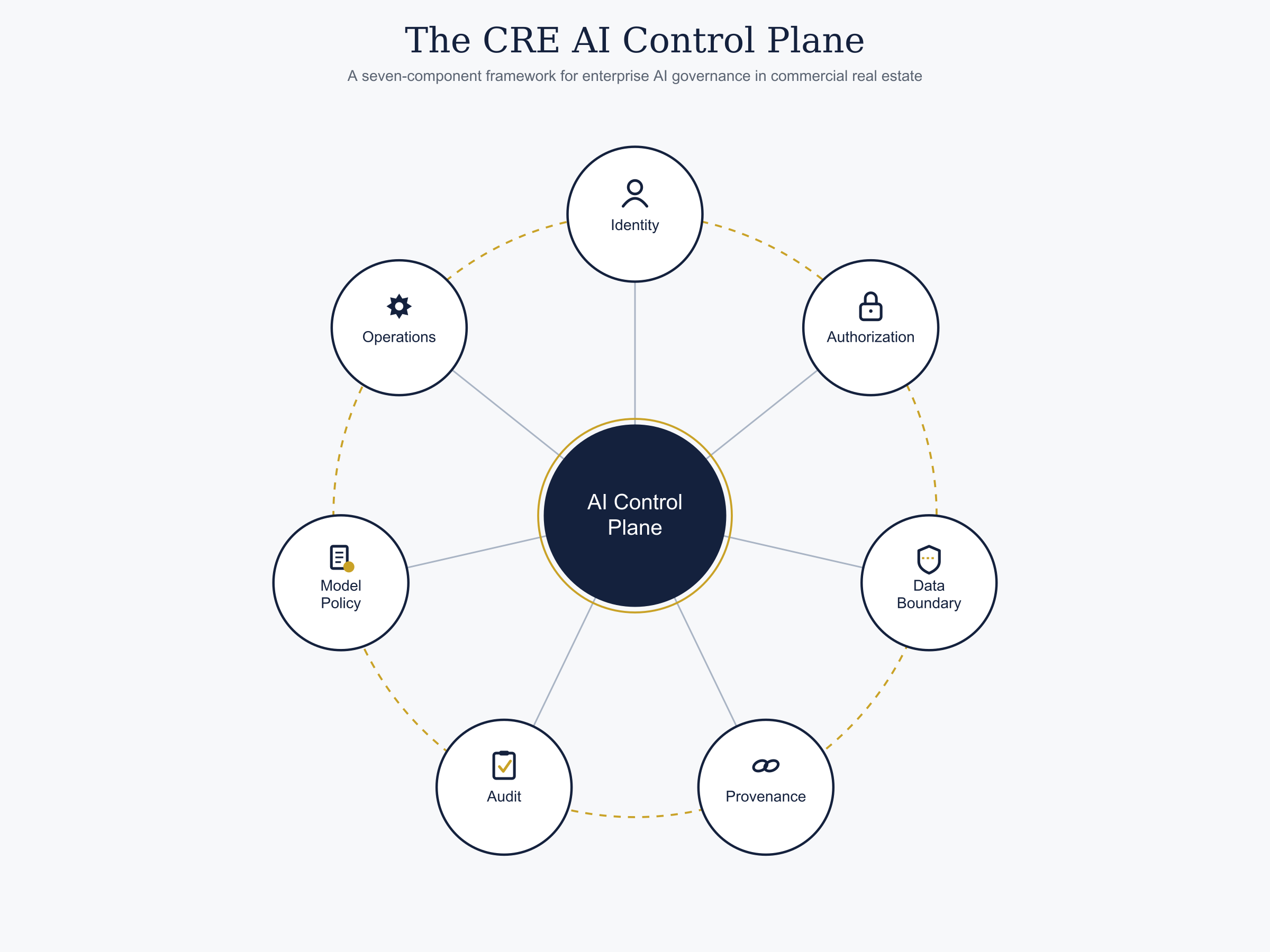
- The CRE AI Control Plane organizes enterprise AI governance into seven components: Identity, Authorization, Data Boundary, Provenance, Audit, Model Policy, and Operations.
- Access control has to be enforced before data retrieval, not applied by filtering an already-generated answer; filtering after the fact is not a reliable security boundary for sensitive fund, property, or tenant data.
- Prompt injection has held the top-ranked risk position for two consecutive editions of OWASP's Top 10 for LLM Applications, and CRE systems face it wherever an AI tool ingests external documents such as leases, offering memos, or emails.
- A citation on an AI-generated answer makes that answer traceable and reviewable; it does not certify that the underlying source data is correct, which is why provenance and data-quality governance are separate, complementary controls.
- Vendor evaluation should treat deployment, access, provenance, audit, and incident response as one connected package rather than scoring any single control in isolation.
What enterprise AI governance actually means for CRE
Enterprise AI governance, in a CRE context, is the set of controls that determine who can ask an AI system a question, what data that system can retrieve to answer it, where that data is processed, whether the answer can be traced back to its source, and what happens when something goes wrong. It is broader than a single training-data policy, because a system can pass that one question and still fail on access enforcement, data location, or incident response.
CRE portfolio data carries specific sensitivity: fund-level financials, tenant lease terms, investor commitments, and often material nonpublic information tied to acquisitions or dispositions. A governance model built for a generic internal chatbot doesn't automatically transfer to that data without deliberate attention to fund and joint-venture segregation, document-level access controls, and audit requirements that satisfy investor and lender expectations, not just internal IT policy.
Good governance treats these controls as interdependent. A strong access model without audit logging leaves no record of who saw what. Strong provenance without enforced access control means a citation can accurately point to data the requester shouldn't have seen in the first place. The rest of this article works through each piece before showing how they connect.
Deployment models and data boundaries
Where an AI system actually processes and stores data is the first architectural question in any enterprise review, and it shapes almost everything downstream.
Three deployment patterns are common across enterprise AI generally. A shared, multi-tenant SaaS deployment hosts data on vendor infrastructure, logically separated between customers; it's typically the fastest to stand up and often the least suited to highly sensitive financial data without additional scrutiny. A dedicated, single-tenant deployment still runs on vendor infrastructure but isolates a customer's instance from others, offering a middle tier of control. A deployment inside the customer's own cloud environment keeps data within infrastructure the customer already controls and audits, which is typically the pattern CRE firms gravitate toward for portfolio financial data given the sensitivity involved.
Bayaan is built on Microsoft Azure and deploys against a customer's data inside that customer's own Azure environment, which places the data boundary question inside infrastructure the customer already governs rather than a separate vendor-hosted store. That deployment choice doesn't remove the need for the rest of the controls in this article — it's one component of the picture, not a substitute for access control, provenance, or audit.
Training-data policy: what "we don't train on your data" does and doesn't cover
A vendor confirming that customer data isn't used to train its models is a necessary answer, not a complete one. It addresses one specific risk: that a company's proprietary lease terms or financial data could end up embedded in a model that serves other customers. It says nothing about whether the right people inside the organization can see the right data, whether that data leaves the customer's environment during normal operation, or how an incident gets handled if something goes wrong.
Bayaan's data handling model states plainly that customer data is not used to train AI models, that data stays within the customer's Azure environment under the customer's own access model, that answers carry source citations, and that administrative actions are audit-logged. That combination — no training use, defined data residency, citations, and logging — is closer to a complete governance answer than the training question alone, but a reviewer should still confirm each piece independently rather than treating "we don't train on your data" as covering the rest.
Access control at a glance
Role-based access control for CRE AI has to determine what a user can retrieve or query before an answer gets generated, not filter a completed answer after the fact. The distinction matters because a system that generates a full answer and then redacts parts of it has already processed data the requester may not be authorized to see, which creates exposure the redaction step can't fully undo.
At a conceptual level, this involves row-level access — restricting which properties, funds, or transactions a user's queries can touch — and column-level access, restricting which fields within an allowed record a user can see, such as a specific tenant's negotiated rent versus general occupancy data. CRE portfolios add a layer most generic enterprise systems don't need to handle: segregation by fund, joint venture, property, and sometimes region, often with different ownership structures and different investor agreements governing who can see what.
This is a large enough topic that it gets its own dedicated treatment; [[LINK: role-based access control for CRE AI]] covers roles, scopes, inherited versus application-specific permissions, and recertification in depth.
Citations and provenance as governance controls
A source citation on an AI-generated answer is a governance control, not a convenience feature. It gives a reviewer a way to trace a number back to the system and record it came from, which is what makes an AI-generated answer reviewable and challengeable rather than something the organization has to simply trust.
A citation does not verify that the underlying source data is correct. If a property management system has a miscoded lease record, a citation will accurately point to that flawed record — the citation confirms lineage, not accuracy. That distinction matters for how much weight an organization should put on a citation: it's the minimum standard for using AI-generated numbers in decisions or reports, not proof that those numbers are right.
[[LINK: why source citations matter for CRE data]] covers the specific standard a citation needs to meet and how review workflows should treat AI-generated numbers headed into investor, board, or lender materials.
Audit logs, model routing, and incident response
Audit logging needs to capture who asked what, when, and what data was touched — not just whether the system was available. For CRE portfolio data, that log becomes relevant not only for internal security review but potentially for investor or lender inquiries about how a reported number was produced.
Model routing is a less obvious governance question that matters more as enterprise AI systems mature: which model actually processes a given request, whether that routing ever sends data to a third-party model provider, and what terms govern that provider's handling of the data if so. Bayaan's platform includes multi-model routing as part of its governed architecture, and a reviewer should ask any vendor exactly this question rather than assuming a single-model, single-provider setup by default.
Incident response is where governance intent gets tested. A defined process needs to answer, in advance, what happens if a permission gap is discovered, if an audit log shows unexpected access, or if a model produces an output that shouldn't have been possible under the access model. Waiting to design that process until an actual incident occurs is a common and avoidable gap.
Prompt injection and document-borne risk
Prompt injection is a distinct risk category from access control, and it matters specifically for CRE because of how often the industry works with ingested documents — leases, offering memos, appraisal reports, email correspondence — that an AI system might read as part of answering a question or abstracting a document.
According to OWASP's 2025 Top 10 for LLM Applications, prompt injection has held the top-ranked risk position for two consecutive editions of the list, and the current definition explicitly covers both direct injection, where a user types a malicious instruction, and indirect injection, where the model reads untrusted content from an external source such as a document or website and follows instructions embedded in it rather than treating that content as data to analyze. A lease document or email thread containing hidden or unusual text designed to alter the model's behavior is exactly the indirect scenario the current OWASP guidance describes.
No enterprise AI vendor can claim complete immunity to this risk category today; the meaningful question in a vendor review is what mitigations exist and how failures are contained if an injection attempt succeeds, not whether the risk has been eliminated entirely.
The CRE AI Control Plane
The controls covered so far connect into one operating model. The CRE AI Control Plane organizes them into seven components that together determine whether an enterprise AI system is safe to use on portfolio data.
| Component | What it covers | Key question to ask a vendor |
|---|---|---|
| Identity | Confirms who is actually asking the question | Does the system integrate with our existing SSO or identity provider? |
| Authorization | Confirms what that identity is allowed to see or do | Is access enforced before data retrieval, or only by filtering the answer afterward? |
| Data Boundary | Where data is processed and stored | Does data ever leave our environment, and if so, to where? |
| Provenance | Whether an answer can be traced to its source | Does every answer carry a citation back to the originating record? |
| Audit | Whether actions and access are logged | What administrative and access actions are logged, and for how long are they retained? |
| Model Policy | Which models process requests, and under what terms | Is our data used to train any model, and how is third-party model routing handled? |
| Operations | Who owns ongoing monitoring, incident response, and governance | Who internally is accountable for reviewing access, logs, and incidents on a recurring basis? |
The Operations component is where governance ownership becomes concrete rather than aspirational. Someone inside the organization — typically a joint owner across IT, data governance, and the business sponsor — needs explicit responsibility for reviewing access on a schedule, investigating anomalies in the audit log, and updating the access model as fund structures, teams, and roles change. A control plane with six strong technical components and no assigned operational owner still fails in practice, because nobody is watching it after the initial rollout.
Applied to a real query: an analyst asks, "What's total CapEx by property this quarter for the West Fund?" Identity confirms the analyst authenticated through the firm's existing SSO. Authorization checks their assigned role and confirms the West Fund falls within their access scope; a property outside that scope wouldn't return a result at all, not a redacted one. Data Boundary means the query executes against data inside the customer's own Azure environment. Provenance means the returned figure carries a citation to the underlying CapEx ledger entries. Audit means the query, the requester, and the fact that it was answered are logged. Model Policy means the request routes to the model configured for that workspace, and the interaction is not used to train any underlying model. Operations means that if the analyst changes teams next quarter, a recertification process catches the scope change and updates their access accordingly.
Where enterprise AI governance still depends on people
A strong control plane reduces risk. It does not remove the need for human judgment and ongoing ownership, and naming the specific limits matters more than a general assurance that the system is "secure."
No automated monitoring replaces a defined human incident-response process. A system can flag an anomaly in an access log; deciding whether that anomaly is a real problem, how far it extends, and what to do about it still requires a person with the authority to act. Permission enforcement is only as strong as the access model feeding it — if fund, joint-venture, or property scopes are mapped incorrectly upstream in the source systems, an AI layer built on top of that model inherits the same gaps rather than fixing them. Prompt injection risk cannot be fully eliminated by any vendor today, particularly the indirect form triggered by ingested documents; mitigation reduces the risk, it doesn't guarantee immunity. Vendor certifications and compliance claims change over time and vary by product tier, so any specific claim about a certification or compliance standard should be verified directly with the vendor at the time of evaluation rather than assumed from marketing content, including this one.
Run a real governance review
Evaluate deployment boundaries, access enforcement, provenance, audit, model policy, and operations as one connected control plane.
Talk to BayaanA vendor evaluation checklist for enterprise CRE AI
Running a structured evaluation, rather than a single conversation about training data, is what actually surfaces the gaps that matter.
- Confirm the deployment model in writing: whose infrastructure processes and stores the data, and does any of it leave that boundary during normal operation.
- Request a walkthrough of how the system enforces fund, joint-venture, and property-level access before data retrieval, not a description of how it redacts output afterward.
- Ask to see what an actual audit log entry contains, not just a description of "full audit logging."
- Confirm how citations work end to end: what a user can click or inspect, and whether that traceability survives when an answer moves into a generated document.
- Ask specifically how model routing works, whether any part of a request is ever sent to a third-party model provider, and under what data-handling terms.
- Request the vendor's incident-response process for a permission gap or unexpected access finding, including who gets notified and how quickly.
- Ask which certifications or compliance standards currently apply to the product, and verify that status directly rather than relying on a general claim.
- Assign an internal owner for ongoing review before rollout, not after the first access-related question comes up.