
In this article
Commercial real estate firms have more data than ever. Natural language querying (NLQ) allows users to ask questions in everyday language instead of writing SQL or navigating complex reporting systems.
Key Takeaways
- NLQ enables plain-English access to portfolio data.
- CRE data is unusually complex because of hierarchies, lease amendments, effective dates, and conflicting metric definitions.
- Intent match, query correctness, and answer correctness are distinct evaluation criteria.
- Transparency and citations are critical for enterprise adoption.
What Is Natural Language Querying?
Natural language querying is a method of retrieving information from data systems using human language instead of technical query syntax.
For example, a user can ask:
“Show me properties below 85% occupancy.”
Instead of writing SQL, the user expresses the business question directly. The system then has to determine what the question means, map the language to the underlying data model, retrieve the relevant information, and return an understandable result.
Why Earlier Generations Struggled
Earlier natural-language systems often depended on rigid templates. They could work well for predictable questions but struggled when users introduced ambiguity around occupancy, portfolio scope, reporting periods, or other business definitions.
Commercial real estate makes these issues especially visible because the same business word can refer to different measurements depending on the context.
CRE-Specific Challenges
A useful NLQ system for CRE has to understand more than everyday language. It needs to work with the structure and history of portfolio data.
- Multiple hierarchies: property, market, fund, and portfolio levels can all matter.
- Conflicting metric definitions: business teams may use different definitions for the same metric.
- Effective dates and historical truth: the correct answer can depend on what was true at a particular point in time.
- Tenant, lease, and property relationships: questions often require connecting several related entities.
How a Modern NLQ Workflow Works
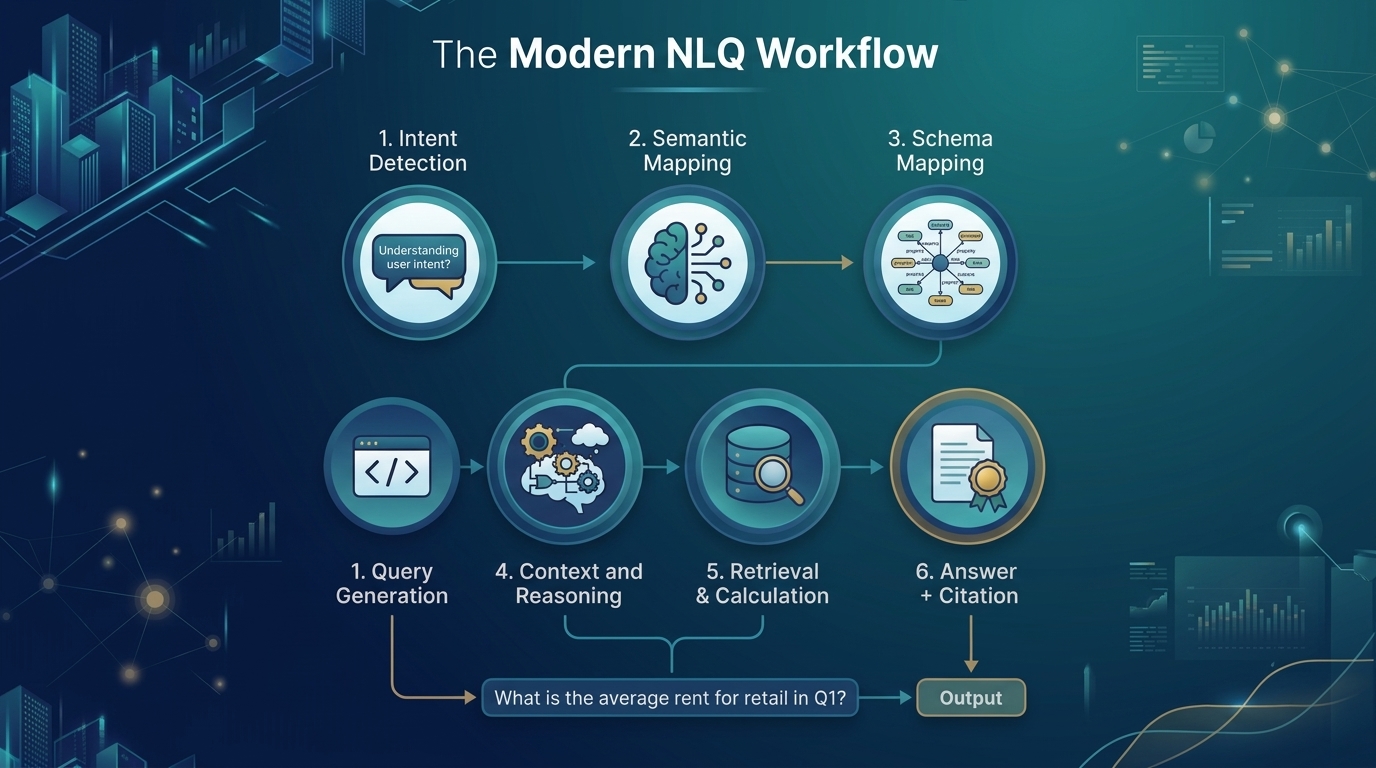
A modern natural-language querying workflow can be understood as a sequence of six stages:
- Intent Detection: understand what the user is actually asking.
- Semantic Mapping: map business language to the organization's definitions.
- Schema Mapping: identify the relevant entities, fields, relationships, and hierarchy.
- Query Generation: translate the interpreted request into the appropriate data query.
- Retrieval & Calculation: retrieve the relevant records and perform required calculations.
- Answer + Citation: explain the result and expose the supporting source context.
The important point is that generating a syntactically valid query is only one part of the process. The system must first understand the business question and then communicate the resulting answer accurately.
Ask your portfolio questions in plain English
Talk with Bayaan about giving your CRE team governed, source-aware access to portfolio data.
Talk to BayaanIntent Match vs. Query Correctness vs. Answer Correctness
These three layers should be evaluated separately. A system can understand a question correctly but retrieve the wrong data. It can retrieve the right data but explain the result incorrectly.
| Layer | Description |
|---|---|
| Intent Match | Understand the question |
| Query Correctness | Retrieve the right data |
| Answer Correctness | Explain results accurately |
This separation gives CRE teams a better way to evaluate AI systems than simply asking whether an answer “sounds right.”
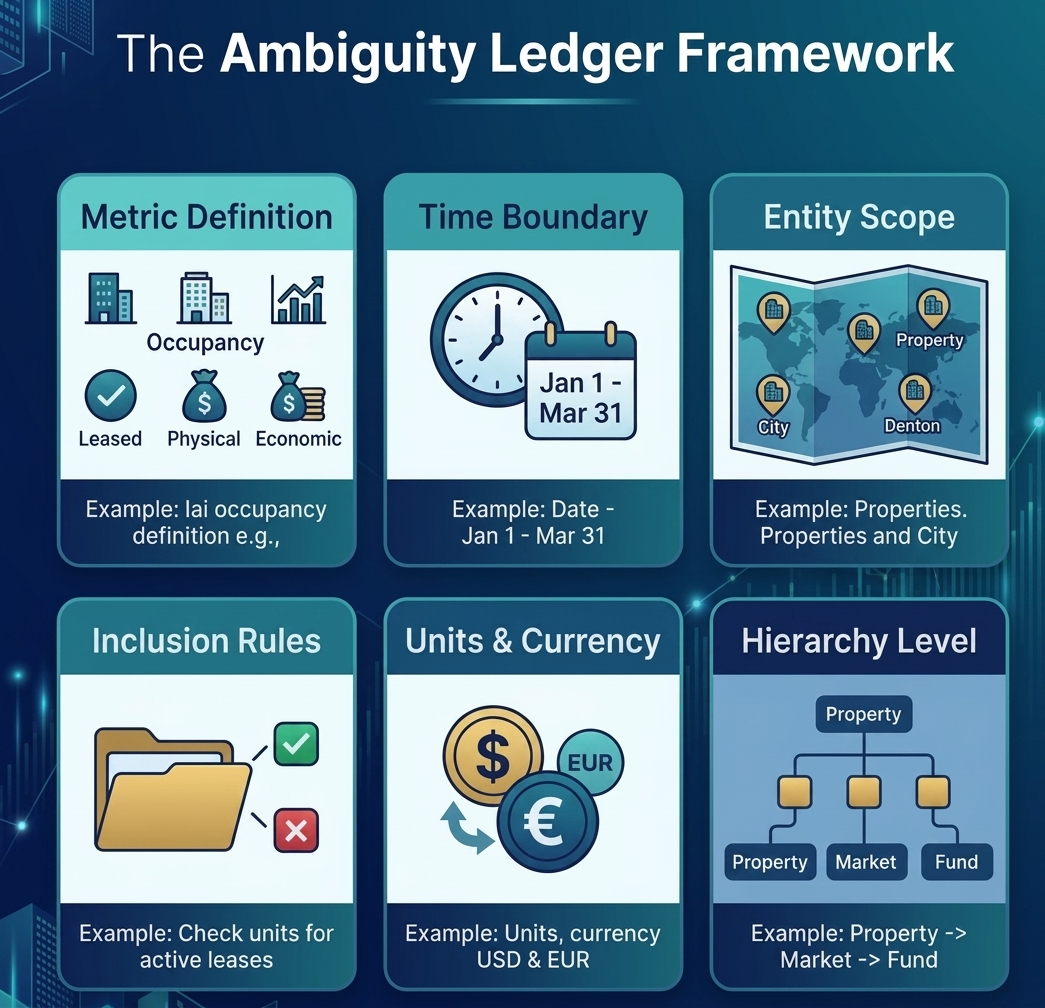
The Ambiguity Ledger Framework
Many natural-language questions contain hidden decisions. An ambiguity ledger makes those decisions explicit before they silently influence the result.
| Ambiguity Area | Example |
|---|---|
| Metric Definition | Occupancy |
| Time Boundary | Last Quarter |
| Entity Scope | Portfolio |
| Inclusion Rules | Active Leases |
| Units & Currency | Revenue |
| Hierarchy Level | Property vs Fund |
Making these dimensions visible is particularly important for questions that will be used in investment, operating, or reporting workflows.
Transparency and Citations Matter
A natural-language answer is more useful when users can understand how it was produced. Transparency helps reviewers determine what source was used, what scope was considered, and which definitions or filters shaped the result.
Citations are therefore not simply a presentation feature. They are part of the trust model for enterprise analytics. A result that cannot be traced is harder to challenge, reproduce, or approve.
Limitations of Natural Language Querying
- Metric disagreements require governance.
- Source-system errors propagate downstream.
- Complex judgment remains human.
- Historical reconstruction is difficult.
- Ambiguous questions may require clarification.
NLQ changes how users access data; it does not remove the need for strong source data, business definitions, governance, or human judgment.
Evaluation Checklist for CRE Teams
- Intent Recognition
- Schema Awareness
- Definition Governance
- Ambiguity Management
- Source Visibility
- Historical Accuracy
- Security
- Auditability
These criteria help teams evaluate whether an NLQ system is ready for governed enterprise use rather than judging it only by the fluency of its responses.