

In this article
A submarket occupancy number drops two points between reporting periods, and the Monday portfolio call is three days out. The asset manager needs to know which properties moved, whether it's a lease expiration, a leasing gap, or a data-entry error, and what to tell the investment committee. The old path runs through an analyst request, a data pull, and a wait.
This article maps where AI actually changes that path for asset managers: which weekly and monthly tasks it speeds up, how a variance investigation runs from question to evidence, and what still has to stay a human decision. It uses a six-step loop that applies to any recurring portfolio question, not just NOI.
Key takeaways
- AI's main value for asset managers is shortening the gap between spotting a portfolio signal and having the property-level evidence needed to explain it, not replacing judgment.
- The workflows where AI helps most are recurring and diagnostic: variance investigation, expiration tracking, occupancy monitoring, CapEx review, and tenant concentration checks.
- A useful AI answer still needs a traceable source, a stated time period, and a stated scope, because terms like "occupancy" or "NOI" carry more than one definition across firms.
- The Asset Manager Question Loop (Monitor, Ask, Drill, Verify, Act/Assign, Report) gives a repeatable structure for turning a signal into a decision.
- AI does not replace judgment in tenant negotiations, capital allocation, or asset strategy; it changes how fast the evidence behind those decisions gets assembled.
- Report generation only works well when metric definitions and data grain are already governed, not decided at the moment someone asks a question.
What "AI for asset management" actually means
For an asset manager, AI-enabled analysis is a governed system connected to the same data an analyst would otherwise pull by hand: rent roll, general ledger, budget, CapEx tracker, lease abstracts. It answers a specific question in natural language and shows where the number came from, rather than requiring a request ticket and a wait for a formatted export.
That's different from a static dashboard, which shows what someone anticipated you'd want to see on a fixed cadence, and different from a general-purpose AI assistant, which cannot see live portfolio data unless a file is uploaded question by question. For the broader category this sits inside, see what modern CRE analytics platforms need to support.
The practical test is not whether the answer sounds fluent. It's whether it's scoped to the right time period and portfolio segment, whether the number traces back to a source, and whether a follow-up question keeps the same filters instead of silently resetting them. Bayaan, for example, connects to a customer's live business data inside the customer's own Azure environment and returns each answer with a source citation attached, rather than a static export someone has to double-check by hand.
Where AI fits in an asset manager's weekly and monthly cadence
Asset management runs on a cadence: daily one-off questions, a weekly scan for what changed, a monthly variance narrative, and a quarterly push for investor or lender materials. AI does not compress every stage equally.
| Cadence | Typical task | Where AI helps | What stays human |
|---|---|---|---|
| Daily / ad hoc | Answering a one-off question from a colleague or lender | Pulling the current number with a citation instead of opening an analyst ticket | Judging whether the number is decision-ready as-is |
| Weekly | Scanning for occupancy, leasing, or budget changes since the last review | Surfacing what moved and by how much, property by property | Deciding which changes deserve escalation |
| Monthly | Building the variance narrative for the asset-management review | Drilling from portfolio to property to account for the driver | Writing the recommendation and the next step |
| Quarterly | Preparing investor or lender-facing materials | Assembling the supporting detail behind each cited metric | Approving tone, framing, and disclosure |
The daily and weekly rows are where the time savings compound. A one-off question that used to sit in an analyst's queue for a day can get answered in minutes, which changes how often an asset manager checks in on a portfolio rather than waiting for the monthly close to surface a problem.
[[SME: In real Bayaan/ARC asset-management deployments, which single question do asset managers ask most often in the first two weeks after onboarding?]]
Using AI to investigate a variance before it reaches an investor call
Consider a hypothetical portfolio where quarter-over-quarter NOI is down at the aggregate level. The old workflow starts with an email to an analyst, a data pull against the general ledger, and a return trip if the first cut raises more questions than it answers.
A conversational workflow compresses the first three steps into one sitting. The asset manager asks for NOI by property for the current quarter versus the prior quarter, sorted by variance. The system returns two properties driving most of the decline. A follow-up question, asking it to break the larger property's variance down by revenue and expense account, surfaces a spike in repairs and maintenance that turns out to be a CapEx project miscoded as operating expense rather than a real operating problem.
That diagnostic chain, from portfolio to property to account, is where AI adds the most value: it removes the wait between each step, not the interpretation at the end of it. It's one instance of a pattern that repeats across the main ways AI analyzes a CRE portfolio, from lookup through diagnosis. The asset manager still has to recognize a miscode when they see one, and still has to decide whether the fix is a journal entry correction or a conversation with the property accountant.
Two things make this reliable instead of misleading. First, the comparison period has to be defined the same way each time; a budget-to-actual comparison and a prior-year comparison are different questions that can look similar in a chat interface. Second, same-store logic has to be applied consistently, or a property added to the portfolio mid-quarter will distort the variance in either direction.
[[SME: What is a real limitation asset managers have run into when asking Bayaan to compare data across two different accounting periods or a changed chart of accounts?]]
Tracking expirations, occupancy, and tenant concentration without a standing report request
Three portfolio questions come up on a near-constant basis for asset managers: what's expiring and when, how occupancy is trending, and how concentrated the rent roll is in a small number of tenants. Each one traditionally required either a standing report someone had to remember to update or a fresh request to an analyst.
An AI assistant connected to lease and rent-roll data can answer these as they come up: which leases expire in the next 180 days by property, how leased occupancy compares to economic occupancy this month, or what percentage of portfolio rent sits with the top five tenants. The value isn't a new metric. It's not having to wait for the report cycle to ask the question.
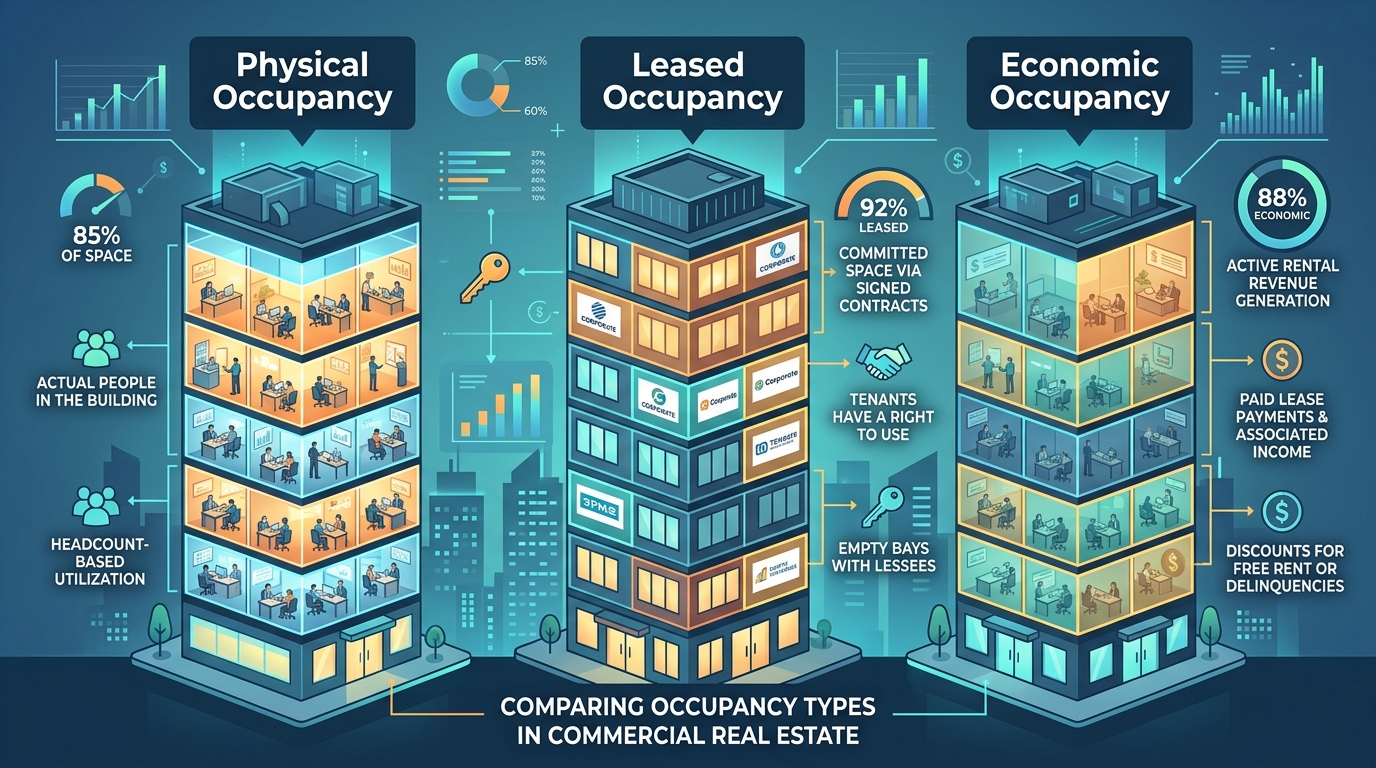
The caveat is definitional, not technical. Physical occupancy, leased occupancy, and economic occupancy answer different questions, and a portfolio can show all three moving in different directions in the same period. An asset manager pulling a quick number still has to know which definition the question requires before treating the answer as complete.
[[SME: What does a Bayaan source citation actually show an asset manager on an occupancy or rent-roll answer, and what can they click or inspect behind the number?]]
Turning a portfolio question into meeting-ready evidence
Meeting prep is where the weekly and monthly workflows meet. Before a portfolio review, an asset manager typically needs three things: what changed, why it changed, and what the recommendation is. AI accelerates the first two by letting the asset manager ask, drill, and re-ask without waiting on someone else's schedule.
The follow-up pattern matters more than the first answer. A single query rarely produces a meeting-ready explanation; it's the second and third questions (why did this move, is this consistent with last quarter, does this affect the annual budget) that build something usable. That only works if the system retains the scope and filters from the first question instead of treating each one as a blank slate.
[[SME: When an asset manager asks a follow-up question that depends on an earlier answer's filters, what does the system do to preserve or flag that context?]]
Where this connects to reporting: an AI-generated answer used in a live meeting and an AI-generated slide sent to an investor are not the same level of scrutiny. The first can move fast because the asset manager is present to explain and defend it. The second needs the same evidence chain, but reviewed and approved before it leaves the building. How to use AI to create commercial real estate asset management reports covers that review step in detail.
The Asset Manager Question Loop
Most asset-management AI use falls into a repeatable pattern rather than a one-off lookup. The loop below gives it a name and a structure that holds across NOI, occupancy, CapEx, and tenant-risk questions alike.
| Stage | What happens | Example |
|---|---|---|
| Monitor | A recurring check surfaces a change worth investigating | Occupancy at a property drops below its trailing-twelve-month average |
| Ask | The asset manager states the question in plain language, with metric, scope, and time period | "Show occupancy by unit type for this property, this month versus last month" |
| Drill | A follow-up question narrows from portfolio or property to the specific driver | "Which units went vacant, and when did those leases end?" |
| Verify | The asset manager checks the source, definition, and date behind the answer before acting on it | Confirming the occupancy figure uses leased, not physical, occupancy |
| Act / Assign | The asset manager decides what happens next and who owns it | Assigning a leasing update request to the property manager |
| Report | The verified finding becomes part of the recurring asset-management review | The variance and its driver appear in the monthly report with the resolution noted |
The loop is deliberately not linear-only. A verify step that turns up a bad number sends the asset manager back to Ask with a corrected question, rather than forward to Act on a wrong one.
[[SME: What does the handoff from an AI-generated variance explanation to a human decision, such as escalating a tenant issue, actually look like in a live deployment?]]
Where this falls short
AI analysis over portfolio data is only as reliable as three things underneath it, and each one has a specific failure mode for asset managers.
Definitions aren't universal, and the system won't guess which one you meant. Occupancy, same-store NOI, and even "CapEx" carry firm-specific conventions. An AI assistant can apply a definition consistently once it's configured, but it can't silently choose the right one for a question that leaves the definition ambiguous.
Source-system errors travel downstream unchanged. If a lease renewal was entered with the wrong start date in the property management system, an AI-generated answer will repeat that error with the same confidence as a correct one. Faster access to bad data is not an improvement.
CapEx states get flattened if they aren't modeled distinctly. Budgeted, committed, spent, and forecast amounts answer different questions. A variance analysis that treats them as interchangeable can show a false overrun or a false surplus depending on which stage got compared to which.
Tenant negotiations and capital allocation decisions sit outside what a data assistant can resolve. The system can surface that a tenant represents a large share of portfolio rent and that their lease expires in nine months. It cannot weigh relationship history, market leverage, or capital constraints the way an asset manager does.
Turn portfolio questions into governed answers
See how Bayaan helps CRE teams connect governed business data, investigate portfolio questions, and generate trusted outputs.
Talk to BayaanHow to evaluate whether this fits your asset-management workflow
Before rolling AI-assisted analysis into a regular routine, work through this list with whoever owns the underlying data:
- Are your core metric definitions (occupancy type, NOI scope, CapEx states) written down anywhere, or only known informally by the team?
- Is your rent roll, GL, and budget data current enough that an answer pulled today reflects this month, not last quarter?
- Does the system show a source and a time stamp on every answer, or only a number?
- Can you ask a follow-up question without losing the filters from the first one?
- Who reviews an AI-generated variance explanation before it appears in an investor or lender document?
- Does access follow the same permission boundaries your team already uses for the underlying systems?
If more than one of these has an unclear answer, the gap is usually in data governance, not in the AI layer itself.