
In this article
A quarterly asset management report usually starts the same way. An analyst pulls occupancy from the property management system, financial variance from the general ledger, a CapEx summary from a spreadsheet nobody else opens, and lease expiration dates from a rent roll that was last reconciled two weeks ago. Then someone has to turn that pile of numbers into a narrative an investor, lender, or executive can read in 10 minutes.
AI can draft that narrative quickly. The harder problem is making sure the draft still says something true: that a stated NOI variance ties back to a real driver, that the driver ties back to evidence a reviewer can check, and that every flagged issue ends with an owner and a next step. A report that reads well but loses that chain is not a shortcut. It is a new source of errors.
This article breaks down what belongs in a commercial real estate asset management report, where each section's data comes from, a reusable structure for connecting metrics to action items, and where an AI-drafted report still needs a human reviewer before it goes out.
Key takeaways
- An AI-drafted commercial real estate asset management report is only useful if it preserves the path from metric to variance to driver to evidence to action, not just polished narrative.
- The standard sections are an executive summary, occupancy and leasing, NOI and financial variance, CapEx status, lease events, risk flags, and action items.
- Each section needs a defined source system and reporting grain, whether asset, property, or portfolio level, before an AI tool can draft it reliably.
- A named framework, Metric, Variance, Driver, Evidence, Action, Owner, gives reviewers a consistent way to check any section of the report.
- The NCREIF PREA Reporting Standards' 2025 expansion pushed institutional real estate managers toward asset-level, machine-readable reporting, the same granularity AI-assisted drafting depends on.
- A drafted report still needs a named human reviewer before it reaches investors, lenders, or the board.
What Is an AI-Generated Asset Management Report?
An AI-generated asset management report is a recurring commercial real estate report in which an AI system drafts the narrative, tables, and section content from live portfolio data, while a human reviewer checks and approves the output before distribution.
The report itself is not new. Most CRE firms already produce monthly or quarterly asset-level and portfolio-level reviews covering occupancy, financial performance, capital spending, and leasing risk. What changes with AI is the drafting step. Instead of an analyst manually pulling numbers from four or five systems and writing commentary by hand, an AI assistant with governed access to that data can produce a first draft in minutes, with the source behind each figure attached.
That draft is only as good as the data underneath it. If occupancy is defined one way in the property management system and another way in the reporting template, the AI system will faithfully reproduce that inconsistency rather than resolve it. Getting real value from AI-drafted reporting depends less on the AI itself and more on whether the underlying metrics, source systems, and reporting grain are already defined clearly enough for a human analyst to draft the same report correctly by hand.
The Sections a CRE Asset Management Report Actually Needs
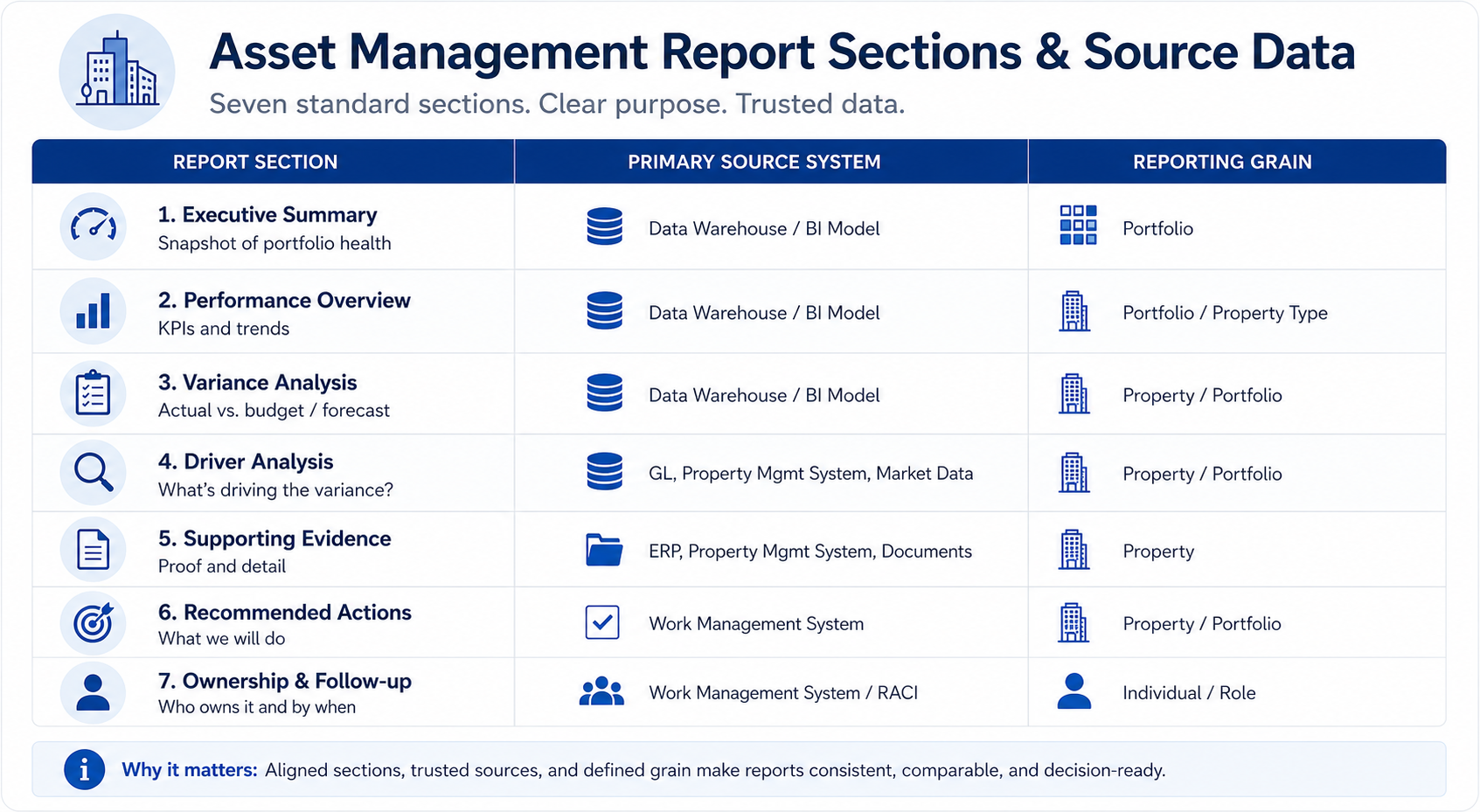
Templates differ by firm, some fold risk flags into the executive summary, others keep a standalone risk section, but most reports draw from the same seven categories of data underneath the formatting.
| Section | What It Covers | Primary Source | Typical Grain |
|---|---|---|---|
| Executive summary | Headline performance, key changes, top risks | Synthesized from every section below | Portfolio or fund |
| Occupancy and leasing | Physical, leased, and economic occupancy; new leases; renewals; rollover | Property management system | Property or asset |
| NOI and financial variance | Actual versus budget, prior period, or prior year | General ledger and budget file | Property or portfolio |
| CapEx status | Approved budget versus spend to date, project status | CapEx tracker or fixed-asset ledger | Property or project |
| Lease events | Expirations, options, and terminations in the period | Lease abstraction data or rent roll | Lease or asset |
| Risk flags | Concentration, rollover exposure, covenant issues | Combination of the above plus underwriting notes | Property or portfolio |
| Action items | Assigned follow-ups tied to a flagged issue | Drawn from risk flags and variance drivers | Asset or task |
That grain requirement is becoming more explicit at an industry level. The NCREIF PREA Reporting Standards, the institutional benchmark for private real estate reporting co-sponsored by the National Council of Real Estate Investment Fiduciaries and the Pension Real Estate Association, expanded in August 2025 to require asset- and investment-level reporting rather than fund-level aggregates alone, and to push firms toward standardized, machine-readable formats instead of static PDF or Excel deliverables (RSM US, 2026; Aprio, 2026). That shift toward asset-level, structured data is the same foundation an AI drafting workflow depends on.
Executive Summary: Write the Headline After the Data, Not Before
The executive summary reads first, but it should be written last. It needs to state what changed, why it changed, and what needs attention, in roughly a paragraph per major topic rather than a single vague sentence per section.
A summary line like "occupancy remained stable and financial performance was in line with expectations" tells a reviewer nothing they can act on. A useful summary line names the number, the direction, and the driver: occupancy held at 91%, but one asset dropped nine points after a tenant termination that is now the leasing team's top priority for the quarter.
If an AI system drafts the summary before the detail sections exist, it has nothing concrete to synthesize and tends to default to that kind of generic language. Drafting order matters here as much as content: detail sections first, summary last, so the headline is actually built from evidence rather than guessed at.
Occupancy, Leasing, and NOI Variance: Where Numbers Need Context
Occupancy and leasing numbers only mean something with variance context attached. A new lease signed this period, a renewal at a lower rate than expiring, or a tenant option not exercised each changes the story behind the same headline percentage.
Portfolio-level averages can also hide the property that actually needs attention. Portfolio occupancy might read 92%, but if one asset dropped from 88% to 74% after a lease termination while the rest of the portfolio held steady, an average obscures exactly where a reviewer should look first. NOI variance has the same problem: a report that shows only the portfolio roll-up can mask a single underperforming property carrying the whole variance.
The fix is not more precision at the portfolio level. It is reporting NOI and occupancy variance at the property level first, then rolling that detail up into the portfolio summary, so a reviewer can trace a headline number back to the specific asset driving it.
CapEx Status and Lease Events
The CapEx section should separate committed capital, the projects already approved and underway, from discretionary capital still under evaluation, and should show approved budget against actual spend to date for each active project. A project running ahead of its completion percentage relative to spend, or behind it, is usually the fastest signal that something needs a closer look.
Lease events work on a different time horizon than the rest of the report. Where occupancy and financial variance describe what already happened this period, lease events should look forward, typically 12 to 24 months, to flag expirations and renewal options before they become a surprise. A report that only shows trailing performance without this forward view leaves the reader unprepared for what is coming.
Turning Variance Into Risk Flags and Action Items
A report that stops at "here is what happened" is a summary. A report that ends with an owner and a next step is something a team can actually work from.
Every material variance or risk flag in the report should close with an assigned action item: who owns the follow-up, and what the next reporting period should show as a result. An AI system can propose that action item based on the pattern of the variance, but assigning the owner and the deadline is a judgment call about staffing and priorities that belongs to a human, not the drafting tool.
Risk flags themselves usually fall into a handful of categories: tenant concentration, near-term rollover exposure, CapEx overruns, and covenant or debt-related issues. Naming the category alongside the specific instance makes the risk section easier to scan across reporting periods and easier to compare property to property.
Drafting vs. Approval: Where AI Stops and a Human Starts
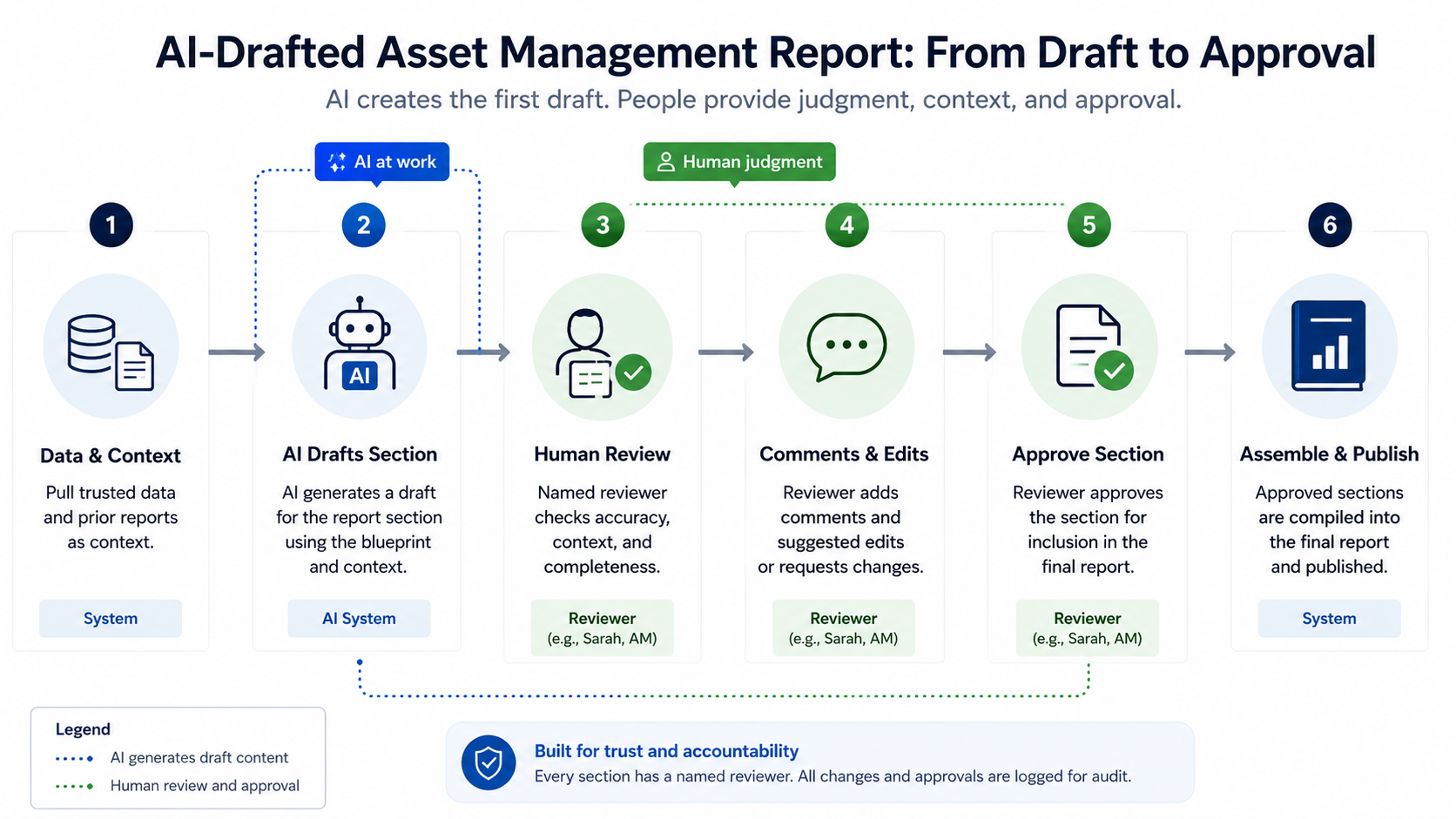
An AI system can draft every section described above once it has governed access to the underlying data: property management records for occupancy and leasing, the general ledger and budget for financial variance, and a CapEx tracker for capital spending. What it should not do is skip the review step that turns a draft into something safe to send to an investor, lender, or board.
A system like Bayaan, built by Al Rafay Consulting on Microsoft Azure, can generate that report draft in PowerPoint, Excel, or Word directly from cited answers to portfolio questions, with every revision saved as a version a reviewer can step back through. The approval step itself still stays with a named human. That reviewer checks that variance drivers are accurate, that action items have real owners, and that the numbers match what the underlying systems actually show before the report leaves the building.
The Asset Management Report Blueprint
Use this sequence to check any section of a report, whether it was drafted by an AI system or by hand: Metric, Variance, Driver, Evidence, Action, Owner. If any of the six fields is missing, the section is not ready to approve.
| Step | What It Answers | Worked Example |
|---|---|---|
| Metric | What number is being discussed | CapEx spend to date on a roof replacement project |
| Variance | How far is it from plan | 18% over the approved budget at 60% project completion |
| Driver | Why did it move | A structural repair scope change identified during demolition |
| Evidence | What source backs this | Change order approved by the property manager, linked in the CapEx tracker |
| Action | What happens next | Revise the remaining budget forecast; escalate to committee if the projected overrun exceeds 25% |
| Owner | Who is responsible | Asset manager for that property, due before the next reporting cycle |
Applied consistently, this sequence keeps a reviewer from accepting a fluent paragraph that never actually answers why a number moved. A section that names the metric and variance but skips straight to a recommendation, with no driver and no evidence in between, is the clearest sign that a draft needs another pass rather than a signature.
Where This Falls Short
An AI-drafted asset management report has real, specific limits worth naming before you rely on one.
Source-system errors propagate straight into the narrative. An AI system has no way to know that a general ledger account was miscoded until a person flags it, and a fluent explanation built on a wrong number is worse than no explanation at all, because it reads as confident.
"Occupancy" is not one number. Physical, leased, and economic occupancy can each tell a different story for the same property, and a report that does not state which definition it is using invites a reviewer to trust the wrong figure without realizing it.
Report templates and same-store logic differ by firm. A structure built around one portfolio's reporting cadence and comparison rules will not map cleanly onto another firm's without adjustment, so treat any framework, including the one in this article, as a starting point rather than a fixed template.
Generated reports still need a human reviewer before they reach investors, lenders, or a board. Approval authority is not something to hand to an AI system, no matter how well-cited the draft is.
Build a reviewable reporting workflow
Move from governed CRE data to evidence-backed, approval-ready reports.
Talk to BayaanHow to Review an AI-Drafted Asset Management Report Before It Goes Out
- Every metric in the report states its source system and as-of date.
- Occupancy figures specify which definition, physical, leased, or economic, is being used.
- Each material variance names a driver, not just a percentage.
- Each driver links to evidence a reviewer can actually open and check.
- Property-level detail exists behind every portfolio-level roll-up number.
- Every risk flag has an assigned owner and a stated next step.
- The executive summary was drafted after the detail sections, not before them.
- A named human reviewer approved the report before it was distributed.