

In this article
An investment committee meeting is on the calendar for Thursday, and the CEO wants to know how much of the portfolio's NOI comes from the ten largest tenants before then. Under the old model, that question goes into the analyst queue behind everything else already in it, and the answer comes back Wednesday night, if it comes back in time at all.
This article covers what changes when a CRE executive can ask that question directly: which questions genuinely belong in self-service, which ones still need an analyst, and what a trustworthy answer has to contain before it goes anywhere near a board deck. It uses a seven-part standard for judging whether an AI-generated answer is actually board-ready.
Key takeaways
- Executive self-service works best on headline questions: what changed, who the biggest contributors are, and where exposure is concentrated, not on judgment calls that require modeling or negotiation.
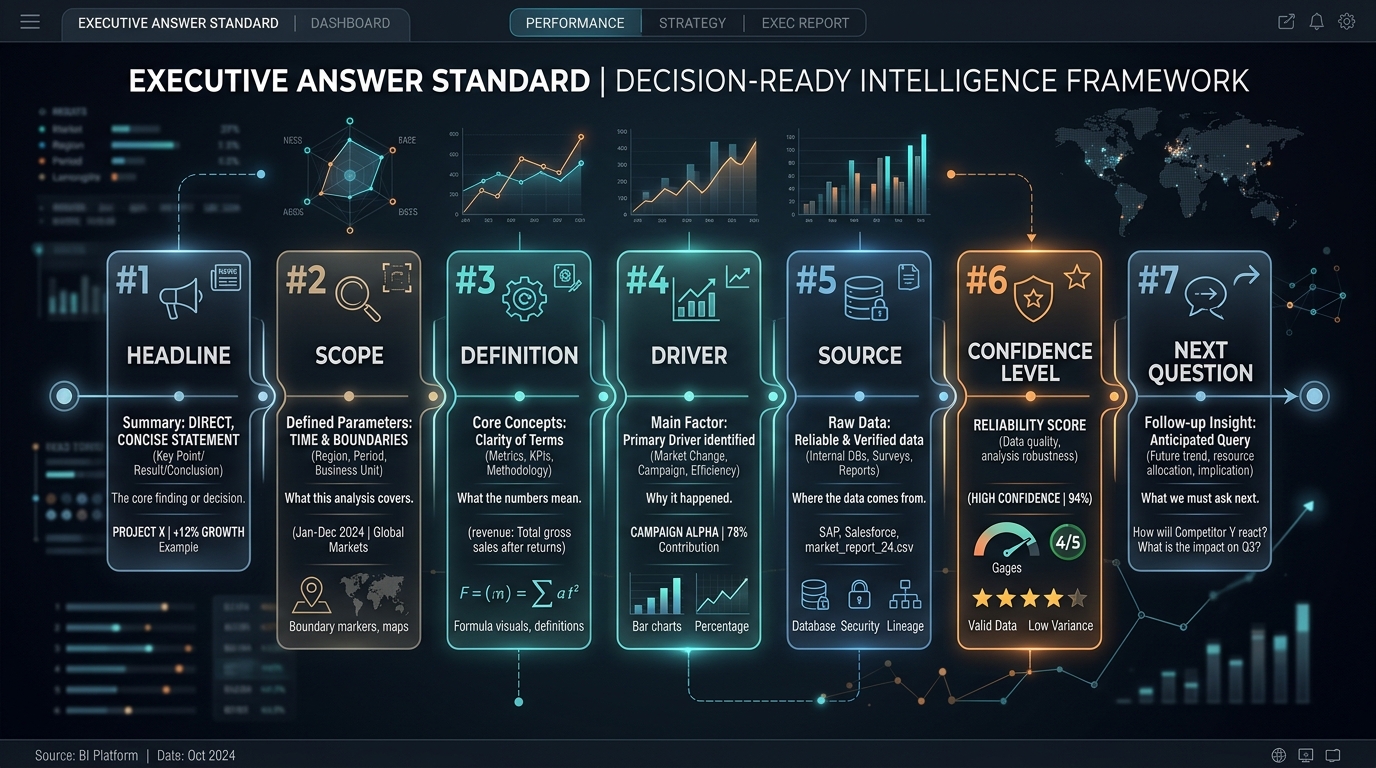
- A board-ready answer needs seven things present at once: a headline number, its scope, its definition, its driver, its source, its confidence level, and a clear next question.
- Self-service reduces the ad-hoc queue an analyst works through, it does not remove analysts from complex, high-stakes, or ambiguous questions.
- Executives asking questions directly still need the same permission boundaries, citations, and definitions an analyst would have applied manually.
- A question hierarchy helps separate what an executive can safely ask a system directly from what should route to an analyst before it reaches a decision-maker.
- Speed without a traceable source just moves the risk from "the answer arrived late" to "the answer arrived wrong."
What "getting a portfolio answer" means for an executive
For an executive, self-service means asking a governed system a direct question about the portfolio, in plain language, and getting back a number with enough context to trust it or challenge it, without opening a request with an analyst first.
That's a narrower claim than it sounds. It does not mean the executive builds their own analysis from raw data, and it does not mean every question gets a same-day answer without human review. It means the class of questions that are largely lookup and comparison, such as this quarter's occupancy versus last quarter's, can be answered directly, while questions that require judgment or new analysis still go to a person.
Bayaan, built by Al Rafay Consulting (ARC), is one example of a system designed around that boundary: it answers natural-language questions against a customer's live business data inside the customer's own Azure environment, with a source citation attached to the answer rather than a number an executive has to take on faith. This kind of self-service sits inside the broader shift covered in what modern CRE analytics platforms need to support.
The questions that used to sit in an analyst's queue
Most executive requests fall into a small number of recurring categories. Naming them makes it easier to see which ones are genuinely self-service candidates.
| Question type | Example | Why it used to require an analyst |
|---|---|---|
| Board or IC prep | "What's our occupancy and NOI trend heading into this meeting?" | Pulling and formatting current figures from multiple systems |
| What changed | "What moved most since last quarter's review?" | Manual comparison across periods and properties |
| Largest contributors | "Which three properties drove most of this quarter's NOI growth?" | Ranking and sorting across the portfolio by hand |
| Outliers | "Which assets are underperforming their budget by the widest margin?" | Cross-referencing budget against actuals property by property |
| Exposure | "What share of portfolio rent comes from our top five tenants?" | Aggregating rent-roll data by tenant across properties |
| Portfolio comparisons | "How does this fund's occupancy compare to the last one at the same point in its life?" | Assembling comparable data across funds or vintages |
Board and IC prep, what-changed questions, and exposure questions are usually the strongest self-service candidates because they're primarily retrieval and ranking. Portfolio comparisons are the shakiest of the group, because "comparable" often hides a definitional choice someone has to make on purpose.
[[SME: Based on real deployments, what's the single most common question executives ask ahead of a board or IC meeting?]]
A board-ready example: tenant exposure before an IC meeting
Return to the Thursday scenario. The executive asks for portfolio NOI by tenant, ranked, for the current quarter. The system returns a ranked list showing the top ten tenants account for a little under half of portfolio NOI, with one industrial tenant representing a noticeably larger share than the rest.
That first answer is a headline, not a finished talking point. The useful next questions are the ones that turn it into something defensible in the room: what's that tenant's lease term and renewal option, is that concentration level higher or lower than a year ago, and does any single property carry an outsized share of that tenant's footprint. Each follow-up narrows the same headline number into something an executive can actually discuss if the committee pushes back on it.
What makes this different from pulling a number off a dashboard is that each answer along the way carries its own source and scope. If a board member asks where the concentration figure came from, the executive can point to the specific rent-roll data and time period behind it instead of describing the number from memory. The retrieve-then-drill pattern here is the same one covered in the main ways AI can analyze a CRE portfolio, just applied at executive rather than analyst depth.
[[SME: What does the Confidence or Assumption element of an executive-facing answer actually show today, and how does an executive interact with it?]]
Where self-service should stop and an analyst should get involved
Self-service earns its value on volume, not on every question. A handful of situations should route to an analyst before an answer reaches a decision-maker, even when the system could technically produce a number.
- The question requires new analysis, not retrieval. Scenario modeling, sensitivity analysis, or anything involving a forecast assumption belongs with an analyst who can state and defend the assumption.
- The data has a known quality issue. If a property's rent roll is mid-migration or a recent acquisition hasn't been fully mapped into the reporting structure, an executive asking a direct question can get a technically correct but practically misleading answer.
- The comparison requires a judgment call. "Comparable" portfolios, funds, or time periods often need someone to decide what counts as comparable before the comparison means anything.
- The answer is going into a disclosure-sensitive document. Investor letters, lender covenant reporting, and audited materials warrant the same review they'd get if an analyst had produced the number by hand.
The point of self-service is reducing how often a routine, low-ambiguity question sits in an analyst's queue, not removing analyst judgment from the questions that actually need it.
[[SME: What is a real example where an executive's self-service question needed an analyst to step in because of a data-quality or definitional issue?]]
The Executive Answer Standard
A board-ready answer needs more than a correct number. The standard below names the seven things that should be present, in order, before an AI-generated answer is treated as decision-ready.
| Element | What it answers | Example |
|---|---|---|
| Headline | What's the number? | "Top ten tenants represent 47% of portfolio NOI." |
| Scope | What portfolio, period, and segment does it cover? | Current quarter, full portfolio, excluding assets under contract for sale |
| Definition | What does the metric mean here? | NOI defined per the firm's standard chart of accounts, before corporate overhead |
| Driver | What's behind the number? | One industrial tenant accounts for roughly a third of that concentration |
| Source | Where did it come from? | Rent roll and GL data as of the stated period |
| Confidence / assumption | What's uncertain or assumed? | Figure excludes a pending lease amendment not yet reflected in the system |
| Next question | What should the reader ask next? | "How does this compare to twelve months ago?" |
An answer missing the definition or confidence line is the one most likely to cause a problem in the room, because it looks complete without actually being checkable. The Source element is what makes an answer reviewable rather than just plausible; see why source citations matter when using AI with CRE data for what a citation should actually contain.
[[SME: When an executive-generated answer ends up in a board or IC document, what does the audit trail actually show, and who can review it later?]]
A question hierarchy for executive self-service
Not every question at the same level of a conversation carries the same risk. Organizing questions by depth helps an executive know when to keep asking directly and when to loop in an analyst.
- Level 1 — Headline lookup. "What's our current occupancy?" or "What was NOI last quarter?" Safe for direct self-service in almost all cases.
- Level 2 — Comparison and ranking. "How does this compare to last quarter?" or "Which properties drove the change?" Still generally safe, provided the comparison basis is defined.
- Level 3 — Driver investigation. "Why did this happen?" Often safe to start directly, but the answer may surface a data-quality flag or definitional question worth an analyst's read before it's repeated externally.
- Level 4 — Judgment and forecasting. "What should we expect next quarter?" or "Is this comparable to our last fund?" Should route to an analyst; this is where assumptions get made, not just retrieved.
An executive who stays disciplined about which level they're asking at gets most of the speed benefit of self-service without inheriting the risk that belongs to Level 4 questions.
[[SME: In practice, what does the handoff look like when a self-service question gets routed to an analyst instead of answered directly?]]
Where this falls short
Executive self-service has real limits, and pretending otherwise is how a fast wrong answer ends up in front of an investment committee.
A confident answer is not the same as a correct one. A system can return a fluent, well-formatted number built on a stale data feed or a mismatched period, and nothing about how it reads will signal that.
Portfolio comparisons hide definitional choices. Two funds, two time periods, or two asset types rarely compare cleanly without someone deciding what "comparable" means, and an executive asking a quick question may not know that choice was made silently.
Source-system errors do not get caught by asking faster. If a lease term was entered incorrectly upstream, a self-service answer repeats that error with the same confidence as a correct one.
High-stakes documents still need a human check. Anything headed for investors, lenders, or auditors needs the same review it would get if an analyst had produced it, regardless of how the draft number was generated.
Turn portfolio questions into governed answers
See how Bayaan helps CRE teams connect governed business data, investigate portfolio questions, and generate trusted outputs.
Talk to BayaanHow to evaluate whether executive self-service fits your team
Before relying on this for board or IC prep, walk through these questions with whoever owns the underlying data and reporting process:
- Does every answer show its source, scope, and time period, or just a number?
- Are your metric definitions (NOI, occupancy, exposure) documented somewhere an executive can check, or only known informally?
- Is there a clear rule for which questions route to an analyst before they reach a decision-maker?
- Does access follow the same permission model your firm already uses for the underlying systems?
- Who reviews a self-service answer before it appears in an investor, lender, or board document?
If most of these have clear answers already, self-service mainly changes speed. If they don't, the gap sits in governance, not in whether the underlying AI is capable enough.